
Small business SEO is the work of making your website and online listings easy for search engines to find, understand and show to people who are looking for what you sell. For a local shop, contractor or service provider, that means three things: a site Google can read, content that answers customers’ questions, and an accurate, well-reviewed Google Business Profile. Most owners can handle the basics themselves. This guide shows which parts those are, what results to expect and when, what professional help costs, and how to tell a good SEO company from a bad pitch.
Key takeaways
- SEO is mostly about clarity: a crawlable site, useful pages written in your customers’ words, and complete business information on Google.
- Plan on months, not weeks. Small businesses typically see first improvements in 3 to 6 months and bigger results within 6 to 12.
- Local searches are won on relevance, distance and prominence, and you cannot pay Google for a better local ranking.
- Agency pricing varies widely. Ask what is included each month and how progress is measured, and be wary of guaranteed rankings.
- Do the basics in-house first, then hand over the technical and time-consuming work.
Table of Contents
- What small business SEO actually is
- Why it is worth the effort
- How long small business SEO takes
- Seven steps you can take this month
- Local SEO: where most small businesses win first
- What SEO services include, and what to keep in-house
- What small business SEO costs
- How to evaluate an SEO company
- Our perspective: keep it simple, keep it local
- Getting help in Virginia Beach
- FAQ
- Sources
What small business SEO actually is
Search engine optimization improves a business’s online presence so it appears more often in search results for the products or services it sells. Technical SEO is the part that helps search engines crawl, understand and index your pages.
The mechanics are simple. Google uses automated crawlers to explore the web and add pages to its index, and sites that follow Google’s Search Essentials are more likely to show up in results. If a page is not indexed, nothing else you do to it matters.
Small business SEO differs from enterprise SEO mainly in scope. You are not trying to rank for thousands of terms nationwide. You want to be the obvious answer for a short list of searches your buyers actually type, usually tied to a service and a place: “HVAC repair Virginia Beach” or “custom furniture Norfolk” rather than a broad head term. Smaller target, tighter focus, faster wins.
Why it is worth the effort
Organic traffic keeps arriving around the clock without a per-click ad cost, and over time it builds your authority as a brand. Position matters too: a 2025 Backlinko report found that only 0.63% of Google users clicked results on the second page. Ranking just below the top results is close to invisible.
SEO also complements paid search rather than replacing it. Ads buy immediate visibility while SEO compounds. If you are weighing the two, our guide to how much a small business should spend on Google Ads covers the paid side, and our piece on why SEO matters to small businesses in Hampton Roads covers the local case.
How long small business SEO takes
This is the question that decides whether owners stay the course. Technical fixes can show early signs, but most small businesses see initial improvements in 3 to 6 months and significant results within 6 to 12 months. Google’s own experts say SEO generally takes four months to a year to implement and show its benefit.
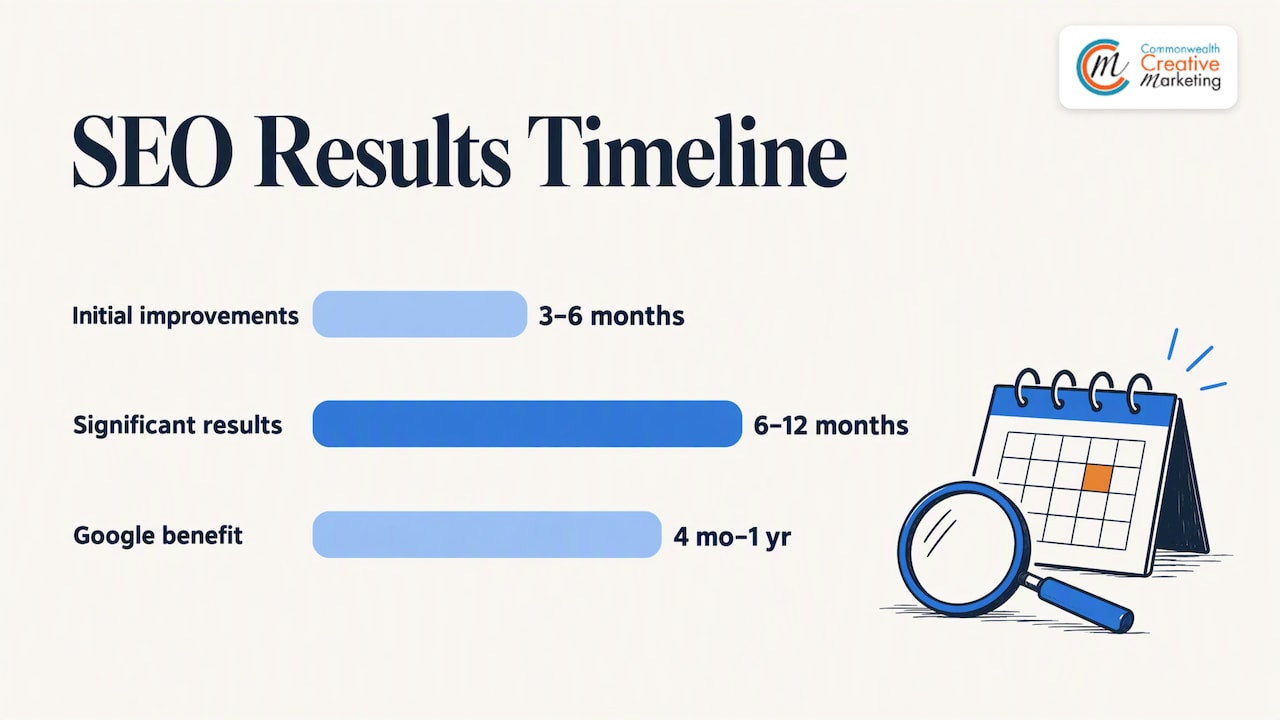
The reason is cumulative. Technical and on-page improvements build momentum before the full result arrives, and the work serves user experience and brand-building as much as raw rankings. Budget for at least six months before judging, and track leading indicators in the meantime: pages indexed, impressions in Search Console, calls from your Google profile, and form submissions.
Seven steps you can take this month
These follow Google’s own SEO Starter Guide and cost little besides time.
- Check whether Google has indexed your site. Search
site:yourdomain.com. If key pages are missing, look in Search Console for technical blockers that stop crawling or indexing. - Set up Search Console and Analytics. You cannot improve what you cannot measure. Search Console shows which queries bring impressions and which pages have problems.
- Make pages crawlable and readable. Pages should render properly, and a sitemap helps when your site is large or new.
- Write for people, in their words. Publish original, current content that matches how customers describe their problem. One page per core service, plus one per location you serve, usually beats a single catch-all page.
- Organize with headings and descriptive internal links. A link that says “emergency water heater repair” tells Google and visitors more than “click here.”
- Remove friction. Avoid intrusive ads and interstitials that cover content, and make sure the site works on a phone. If yours does not, a responsive redesign is often the first real SEO fix.
- Keep publishing. Fresh, useful pages give you more chances to match a search. Our walkthrough on blogging for SEO with WordPress shows a workable routine, and five content improvements for local SEO is a good checklist for existing pages.
Local SEO: where most small businesses win first
If customers come from your area, local results often matter more than the standard listings. Google decides local rankings on relevance, distance and prominence. Relevance is how well your profile matches the search, distance is how close you are to the searcher, and prominence reflects how well known you are, helped by positive reviews and mentions around the web.
Google states plainly that there is no way to pay for a better local ranking. That makes the fundamentals worth getting right:
- Complete your Google Business Profile. Choose accurate categories, list hours, and confirm your location. Incomplete profiles lose to complete ones.
- Ask for reviews as a habit. Ask every happy customer, right after the job, and reply to every review, good or bad.
- Keep your name, address and phone number identical on your website, your profile and the directories you appear in.
- Build location pages that mention the neighborhoods and cities you actually serve, with real details rather than copied text.
We go deeper on the profile in how to improve Google Business Profile rankings and on the map results in Google Map Pack optimization.
What SEO services include, and what to keep in-house
A typical small business SEO engagement can include keyword research, service and location pages, blog content, technical SEO, backlinks, and Google Business Profile optimization. Not all of it needs an outside team.
| Task | Good fit for you | Good fit for a specialist |
|---|---|---|
| Google Business Profile updates, replying to reviews | Yes, you know your customers | Setup and ongoing optimization if you lack time |
| Basic page titles and service descriptions | Yes | When you have dozens of pages |
| Keyword research and page planning | Possible | Faster and more accurate with tools and experience |
| Technical fixes (speed, indexing, rendering) | Rarely | Yes |
| Blog writing | If you enjoy it | If consistency is the problem |
| Link building | No | Yes, carefully |
A practical rule: do what depends on your knowledge of the business, and outsource what depends on tools, technical skill or sustained hours. Owners can handle basic SEO tasks themselves and bring in freelancers or an agency for technical work, blog writing or link building.
What small business SEO costs
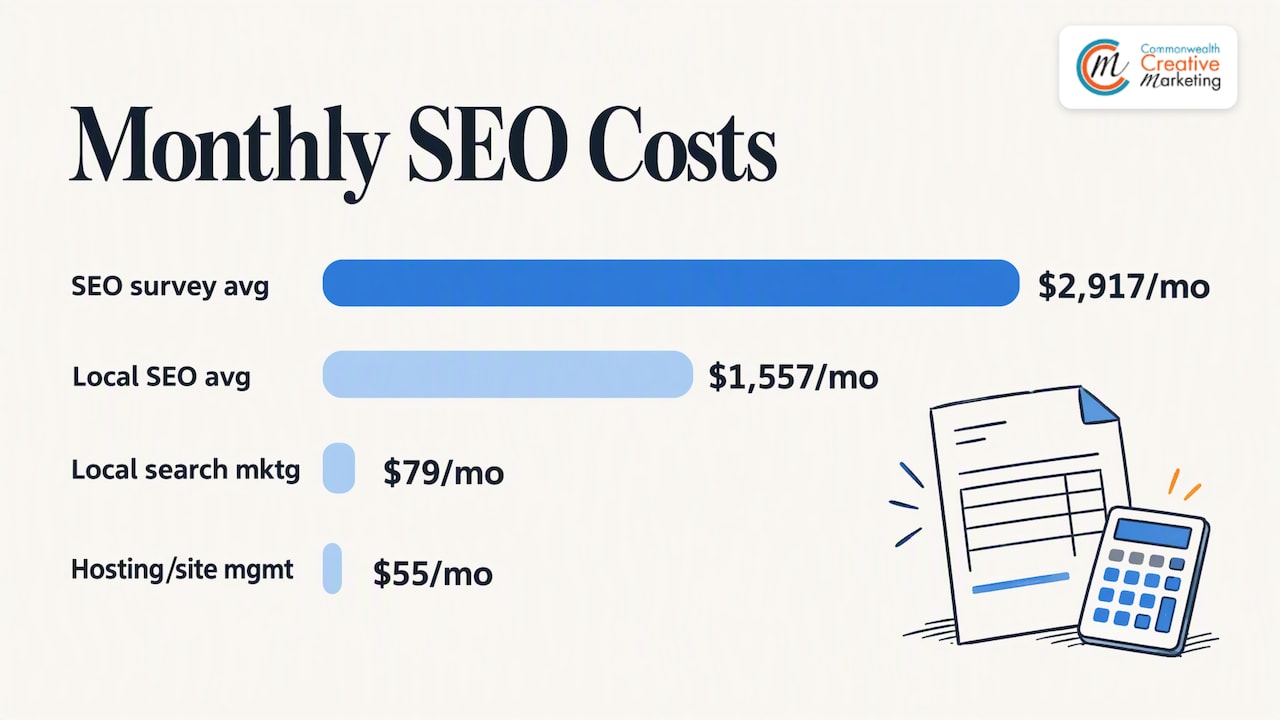
Google’s guide explains good practice but does not give a US price range, so any figure comes from industry surveys, and they differ. A 2023 Ahrefs poll of 439 people reported SEO averaging $2,917 per month, and local SEO averaging $1,557 per month. The same poll found the most common hourly rate was $75 to $100, and 47% of respondents charge between $75 and $200 per hour. Those are survey averages across all kinds of providers, not quotes, and a small local business with a narrow service area rarely needs the full scope behind the average.
What drives the price:
- Competition. A dentist in a crowded market needs more work than a niche trade.
- Number of locations and service areas. Each one needs its own pages and profile.
- Site condition. A site with technical problems needs repair before growth work pays off.
- Content volume. New pages and articles are the biggest recurring line item.
- Who does the work. A hands-on local team differs from a template-based national package.
Our own published pricing starts with local search marketing at $79 per month, which covers the local visibility work described above. Hosting and site management starts from $55 per month, and a new website runs $1,800 to $3,800 one-off. Broader SEO, AI search optimization and Google Ads management are scoped to the business, so we quote them after looking at your market and site.
How to evaluate an SEO company
Use Google’s documented practices as your yardstick. A good provider can explain, in plain language:
- how it will improve crawlability and rendering of your pages;
- how it will make content more useful and original, not just longer;
- how it will handle internal linking;
- how it will measure progress in Search Console, and what it will report to you.
Be wary of proposals built on keyword repetition, intrusive tactics, or promises unrelated to making content useful and accessible. Google’s guide does not endorse guaranteed rankings, and no one outside Google controls them. Also ask who actually does the work, whether you own your accounts and content at the end, and whether you can speak with a client in a similar business.
For a local business, proximity helps. A team that knows your market understands which neighborhoods, competitors and seasonal swings matter. Our local SEO company page explains how we approach that in Virginia Beach.
Our perspective: keep it simple, keep it local
Most small businesses do not need a giant SEO program. They need a site that loads fast and works on a phone, a clear page for each thing they sell, a Google profile that is complete and busy with reviews, and someone watching the numbers month after month. We work exclusively with small, locally owned businesses in Virginia Beach, so we tailor the plan to the owner’s budget rather than selling every owner the same package.
We also think SEO should not live alone. A strong site, consistent branding, a few well-chosen ads and local print or vehicle graphics all send people toward the same search results. When a customer sees your truck, then searches your name and finds a polished profile with fresh reviews, the effort pays twice. That is why we offer web design, hosting, search, paid ads and outdoor advertising under one roof, and why we answer calls and emails quickly.
— User
Getting help in Virginia Beach
If you would rather spend your hours running the business, our local search marketing plan, at $79 per month, handles the profile, listings and reviews work that moves local rankings. For deeper work such as on-site fixes, content and AI search optimization, see our SEO services.
If your website itself is the obstacle, we build and host sites made to be found, starting with a website design project from $1,800. Tell us what you sell and where, and we will show you where your visibility stands today.
FAQ
How much should a small business spend on SEO?
There is no single number. A 2023 industry poll put the average for local SEO at $1,557 per month, but a small business with a narrow service area can start smaller with a focused local plan. Decide based on what a new customer is worth to you and how much competition you face.
Can I do SEO myself?
Yes, for the basics. Claiming and completing your Google Business Profile, asking for reviews, writing clear service pages and checking Search Console are all manageable. Bring in a specialist for technical fixes, ongoing content or link building.
How long before I see results?
Expect initial improvements in 3 to 6 months and significant results within 6 to 12, depending on competition and the condition of your site. Google’s experts say four months to a year is typical.
Is SEO better than Google Ads?
They do different jobs. Ads deliver visibility right away and stop when you stop paying, while SEO takes longer but keeps bringing traffic without a per-click cost. Many small businesses use ads for quick leads while SEO builds.
Can I pay to rank higher in Google’s local results?
No. Google says local rankings rest on relevance, distance and prominence, and cannot be bought. Complete information and good reviews are what move them.
Sources
- Small Business SEO: What It Is & How to Get Started
- SEO Starter Guide: The Basics, Google Search Central
- How long does SEO take to work?
- SEO Essentials Every Small Business Owner Should Know
- Tips to improve your local ranking on Google
- SEO Pricing: How Much Does SEO Cost? 439 People Polled