

A Google Ads agency builds, runs and improves your paid search campaigns so that the money you spend on clicks brings in calls, form fills and sales. For a small business, the real question is not whether agencies exist but whether one fits your budget, your market and the way you like to work. This guide covers what an agency actually does, how fees are structured, how to judge claims, and when it makes sense to hand the account over.
Key takeaways
- An agency handles the ongoing work of campaign setup, keyword and audience choices, conversion tracking, search term review and bid adjustments, not just the launch.
- Google’s own rules require agencies to disclose any management fee in writing before the first sale and on invoices, and to report the exact amount Google charged separately from that fee.
- There is no universal share of revenue you should spend on marketing, so set your ad budget from your own margins and goals before you talk to anyone.
- Ask about reporting, contract length and who touches your account. Be wary of promises of specific results.
- Local businesses often get more from an agency that knows the market, such as Virginia Beach and Hampton Roads, than from a national shop that treats every account alike.
Table of Contents
- What a Google Ads agency does for a business
- Why local context matters more than a big name
- How agencies charge, and what Google requires them to tell you
- Setting an ad budget before you hire
- When professional management makes sense
- How to judge an agency before you sign
- Our perspective
- How CCM handles Google Ads for local businesses
- A simple checklist for your first call
- FAQ
- Sources
What a Google Ads agency does for a business
An agency takes over the daily mechanics of your Google Ads account, and the strategy behind them. Google’s help documentation describes the work involved in running an account: creating and editing campaigns, managing ads and assets, selecting keywords and audiences, setting locations and schedules, measuring conversions, reviewing search terms and landing pages, and adjusting bids. Each of those is a task that someone has to do repeatedly, not once.
In practice, a good engagement looks like this:
- Discovery. The agency learns what you sell, which jobs or products make you the most money, where your customers live and what a new customer is worth.
- Account structure. Campaigns are split by service or product and by location, so budget flows to what pays.
- Keywords and ads. The agency chooses the searches you want to appear for, writes ad copy, and adds negative keywords so you stop paying for irrelevant clicks.
- Conversion tracking. Google’s guidance for action-focused campaigns starts with configuring conversion tracking, choosing a bidding strategy, and setting budgets, locations and audiences. Without tracking, nobody can tell which clicks became customers.
- Landing pages. Ads send people to a page. If that page is slow, confusing or not built for phones, the best campaign will still waste money.
- Ongoing optimization. Search terms are reviewed, bids adjusted, weak ads replaced and budgets shifted as results come in.
- Reporting. You get a clear account of what you spent, what came back, and what changes are planned.
The third step is where small businesses lose the most money on their own. A plumber who bids on “plumbing” with no negative keywords can pay for clicks from people looking for plumbing jobs or plumbing supplies. A careful agency closes those leaks in the first weeks and keeps checking.
Why local context matters more than a big name
Most of the pages that rank for this topic are national agencies that serve ecommerce brands spending tens of thousands of dollars a month. That is a different job from a roofing contractor in Virginia Beach or a boutique near the Oceanfront. Local service campaigns depend on geographic targeting, call tracking, seasonal swings and a Google Business Profile that supports the ads.
Two things are worth checking with any agency:
- Does it understand your service area? Hampton Roads has distinct markets: Virginia Beach, Norfolk, Chesapeake, Hampton and the Peninsula. Ads that cover all of them waste money if you only serve two.
- Does it connect ads to your wider visibility? Paid clicks stop the day you stop paying. Your map listing, reviews and site content keep working. Our guide on getting your business on Google explains the free side of that picture, and local search marketing is the long-term partner to paid ads.
How agencies charge, and what Google requires them to tell you
Fees vary widely, and there is no single standard. Common models include a flat monthly fee, a percentage of ad spend, an hourly rate, or a one-time setup fee plus a monthly fee. Whatever the model, your ad spend is paid to Google. The agency’s fee is separate.
Google’s third-party policy sets rules that protect you here:
- When an agency shares Google advertising cost data, it must report the exact amount Google charged, excluding the agency’s fees.
- An agency that charges a management fee separate from Google Ads costs must disclose that fee to customers, at minimum in writing before the first sale and on invoices.
- If 80% or more of an agency’s customers spend less than $1,000 USD per month on Google Ads, the agency must share Google’s Advertiser guide with all customers who buy those services.
That last rule matters if you are a small advertiser. It tells you Google expects agencies to educate smaller accounts, and you can ask to see that guide before you sign.
Questions to ask about fees
- What is the management fee, and is it flat or a percentage of spend?
- Is there a setup fee, and what does it cover?
- Is the ad budget paid straight to Google from my own account, or does it pass through the agency?
- Who owns the ad account and the data if we part ways?
- What is the minimum commitment, and how do I cancel?
The ownership question deserves emphasis. The account should be in your name, with the agency given access. If you cannot log in and see your own spend, that is a red flag.
Setting an ad budget before you hire
Agency fees are only half of the cost. The other half is what you pay Google for clicks, and that is a decision you make from your own numbers.
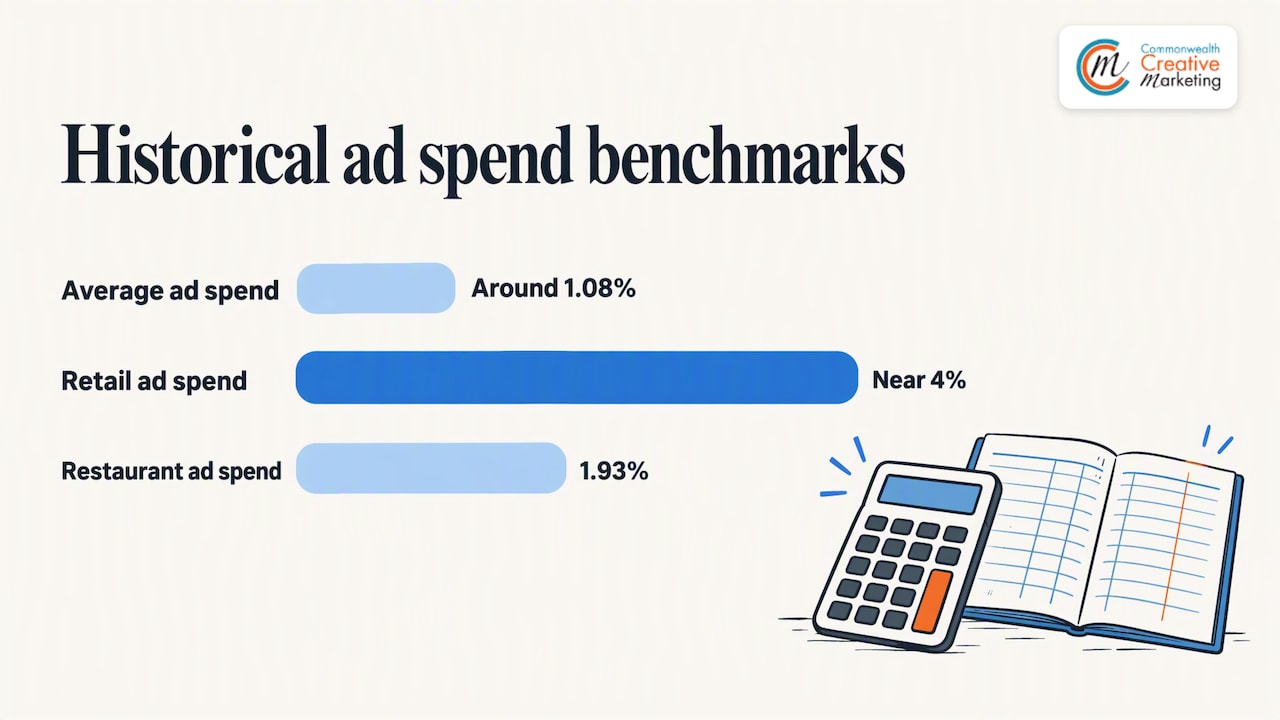
The U.S. Small Business Administration says there is no universal marketing-budget percentage and suggests weighing your revenue, industry, company stage and benchmarks from trade associations or trade publications. The same guide cites an older Small Business Trends finding of average advertising spending around 1.08% of revenue, with retailers near 4% and restaurants at 1.93%. Those are historical figures from 2019 and cover all advertising, not Google Ads alone, so treat them as a rough orientation and not a target.
A more practical way to set a starting point:
- Work out what a new customer is worth to you over a year, in gross profit.
- Decide how much of that you can spend to win one customer.
- Estimate how many leads convert to customers. Even a rough guess from your sales history helps.
- Multiply to find the monthly spend that would bring in the customers you want.
For example, if a new customer is worth $1,200 in profit and you can spend $300 to win one, a month with five new customers justifies $1,500 in total acquisition cost, split between ad spend and the management fee. If your conversion rate is lower than you assumed, the same budget brings fewer customers, which is why tracking in the first 60 to 90 days matters so much. We go deeper on this in our article on how much a small business should spend on Google Ads.
As for the often-asked question of whether $10 a day is enough: it can fund a test in a narrow, low-competition niche, but in a crowded category a few clicks may use the day’s budget. The right answer depends on what a click costs in your market, which you can see in Google’s keyword planning tools once you have an account.
When professional management makes sense
You do not need an agency for every account. Running Google Ads yourself is realistic when you have time, a simple offer and a small test budget. Hiring help usually makes sense when one or more of these is true:
- Your time is worth more than the fee. If you are billing jobs or serving customers, hours spent in the ad dashboard cost you real money.
- You have spent money and cannot tell what worked. Missing or broken conversion tracking is common, and fixing it is often the first win.
- You compete in expensive categories. Legal, home services, medical and similar fields have costly clicks, so mistakes cost more.
- You run several services or locations. Structure gets complicated quickly.
- Your website is holding you back. A site that is slow, outdated or not mobile friendly drags down every campaign.
What affects results most is rarely the ad copy alone. Performance depends on the offer, the landing page, the keywords chosen, your location targeting, your budget relative to competitors, how fast you respond to leads and how well tracking captures conversions. An agency can influence most of those, but not all. If you take three days to return calls, no campaign will save you.
How to judge an agency before you sign
Look at experience that resembles your business
Ask for examples from businesses of your size and type. A case study about a national brand spending six figures a month tells you little about a local contractor. Ask what the starting budget was, what was measured and over what period.
Google runs a Partners program for agencies. Its Premier Partner tier is reserved for the top 3% of participating companies in a country each year, judged relative to other companies. A badge is a signal worth noting, but it reflects account performance across an agency’s whole book, so it does not guarantee the attention your account will get. Ask who will actually manage yours.
Check the reporting
Good reports are short and honest. You should see spend, clicks, conversions, cost per conversion and the actions taken. Under Google’s policy, cost data an agency shares must show the exact charges from Google, excluding fees, so you can check the report against your own account.
Read the contract
Look for the term, the notice period, who owns the accounts and what happens to your data. Short initial terms or month-to-month arrangements are easier to leave if the fit is poor. Longer commitments should come with a clear reason.
Treat guaranteed results as a warning
Nobody controls what Google’s auction does. Be cautious of promises of a specific return, a guaranteed ranking or a number of leads. A trustworthy agency talks about what it will measure, how it will test and when you will have enough data to judge.
Our perspective
We work only with small, locally owned businesses in Virginia Beach and the surrounding area, and that shapes how we see Google Ads. Most of our clients are not looking for a national agency with a long list of enterprise tools. They want someone who answers the phone, explains what the money is doing and does not bury them in jargon.
Our view is that Google Ads works best as one piece of a connected plan. The click is only the start. If the website does not load quickly on a phone, or if the business’s map listing has no reviews, paid traffic leaks away. That is why we build the website, manage the hosting, handle local search and run the ads under one roof. When one team sees the whole path from search to sale, problems are easier to find.
We also believe a small business should never be forced into something it cannot afford. Marketing for a small firm has to start with what you can spend and what a customer is worth, then work outward. Sometimes that means a modest campaign focused on two services in two towns, with room to grow once the numbers prove out.
— User
How CCM handles Google Ads for local businesses
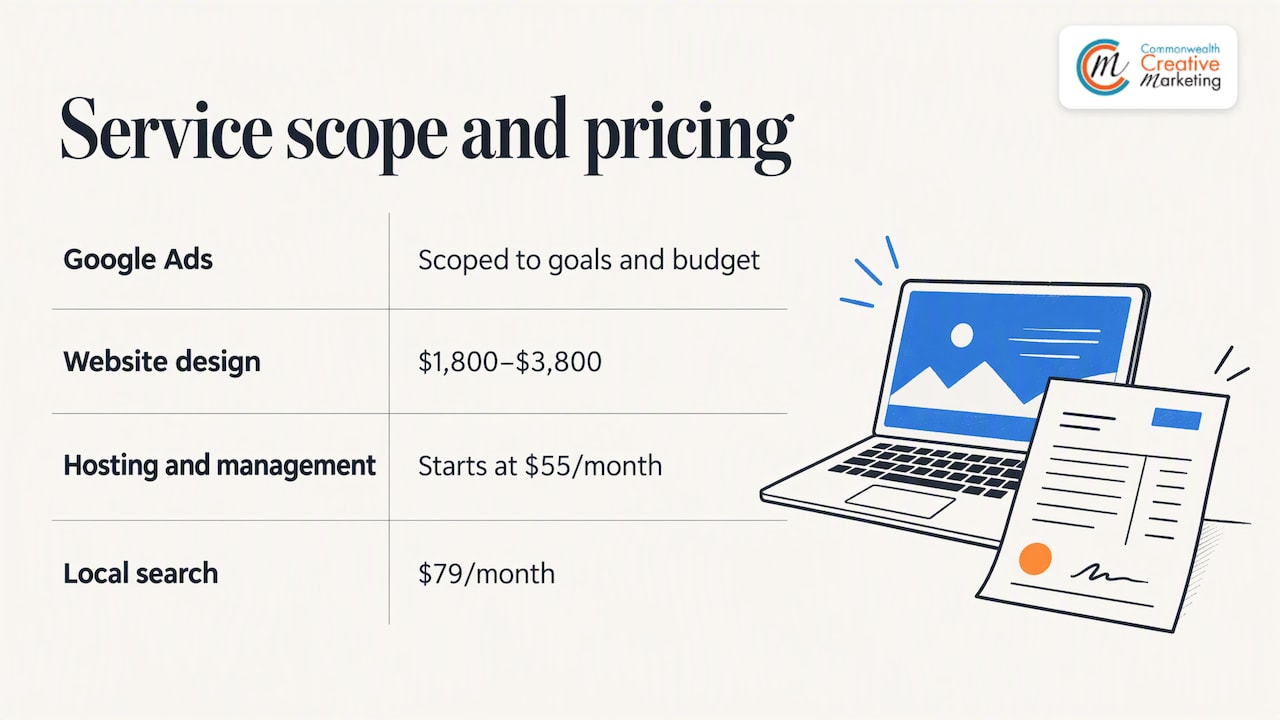
Our Google Ads management covers campaign setup, keyword and audience choices, ad copy, tracking and ongoing optimization for businesses in Virginia Beach, Norfolk and Hampton Roads. We do not publish a price for it, so we scope it with you based on your goals and budget. Where it helps, we pair ads with retargeting to bring back visitors who did not act the first time. Our short piece on the five key elements of a successful pay per click campaign shows how we think about it.
If your site needs work before ads make sense, our website design projects run from $1,800 to $3,800, and hosting and site management starts at $55 per month. For longer-term visibility alongside paid ads, local search marketing is $79 per month. To talk through your situation, reach us through our main site.
A simple checklist for your first call
Bring these to any agency conversation:
- Your top three services by profit, not by volume.
- The towns or ZIP codes you want to reach, and those you do not.
- A monthly ad budget range you are comfortable with.
- Access to any existing Google Ads account, and to your website analytics.
- A realistic sense of how many leads you can handle each week.
Then ask the agency to explain, in plain words, what it would do in the first 30 days, what you would see in the first report and how it would decide whether to keep going, change course or stop.
FAQ
How much does a Google Ads agency cost?
There are two costs: the management fee and the ad spend paid to Google. Fee structures vary by agency, and Google requires agencies to disclose any separate management fee in writing before the first sale and on invoices. Ask for the fee, any setup charge and the minimum term in writing before you commit.
Is $10 a day enough for Google Ads?
It can work as a small test in a narrow niche with low click costs. In a competitive local category, the daily budget may run out after only a few clicks, which leaves too little data to learn from. Check likely click costs for your keywords before you decide, and read our budget guide for small businesses.
What ad agency does Google use?
Google works with a range of agencies and does not hand its own advertising to one shop you can hire. For your own business, what matters is whether an agency participates in the Google Partners program and whether it will manage your account transparently, in your name.
Should a small business hire an agency or run Google Ads itself?
Running it yourself is reasonable if you have time, a simple offer and a small test budget. An agency makes more sense when your time is better spent serving customers, when your tracking is unreliable, or when you compete in costly categories. Either way, track conversions from day one.
Sources
- Navigate your Google Ads serving account, Google Ads Help
- Create a Video action campaign, Google Ads Help
- Google third-party policy, Advertising Policies Help
- How to Get the Most From Your Marketing Budget, U.S. Small Business Administration
- Google Partners Program, Google Ads