
AI search optimization is the work of making your business easy for AI systems to find, understand and recommend when someone asks a question in Google’s AI Overviews, AI Mode, ChatGPT or Perplexity. It builds on traditional SEO rather than replacing it. For a local business, the practical version is simple: clear pages that answer real customer questions, a site AI crawlers can reach, consistent business details across the web, and a way to measure what is happening.
This guide explains how the terms fit together, how AI engines choose what to cite, what to change first on a small-business site, and how to judge an agency that sells this service.
Key Takeaways
- AI search optimization, AI SEO and generative engine optimization (GEO) overlap heavily. All of them extend SEO instead of replacing it.
- AI engines retrieve pages first and cite from that retrieved set, so being found for the questions customers actually ask matters more than polishing page features.
- Specific, factual, self-contained content beats vague marketing copy for small businesses.
- Results are unstable. Track mentions, citations, referrals and leads separately, and judge progress over months.
- A good provider explains its method, shows how it measures, and promises visibility work, not guaranteed placement.
Table of Contents
- What AI search optimization means (and how it differs from SEO)
- How AI engines find and cite business content
- What to change on a small-business website
- A quick checklist you can run in an afternoon
- How to measure AI search visibility
- What generative engine optimization services include
- Our perspective
- Work with a local team on AI search visibility
- FAQ
- Sources
What AI search optimization means (and how it differs from SEO)
You will see several names for the same territory: AI search optimization, AI search engine optimization, generative engine optimization, generative search optimization, answer engine optimization. The labels differ more than the work does.
Search Engine Land describes AI search optimization as the broad practice of making content discoverable, extractable and trusted by AI systems. GEO is a sub-discipline inside it, focused on getting your content cited in AI-generated responses such as Google AI Overviews or Perplexity answers. Both expand on traditional SEO instead of replacing it.
The difference is the goal. Classic SEO aims at a ranking position and the click that follows. According to Search Engine Land, AI-focused optimization targets retrieval, citation and brand recommendation inside an answer the engine writes itself. A customer may never see a list of ten blue links. They see a short answer that names two or three businesses, or none.
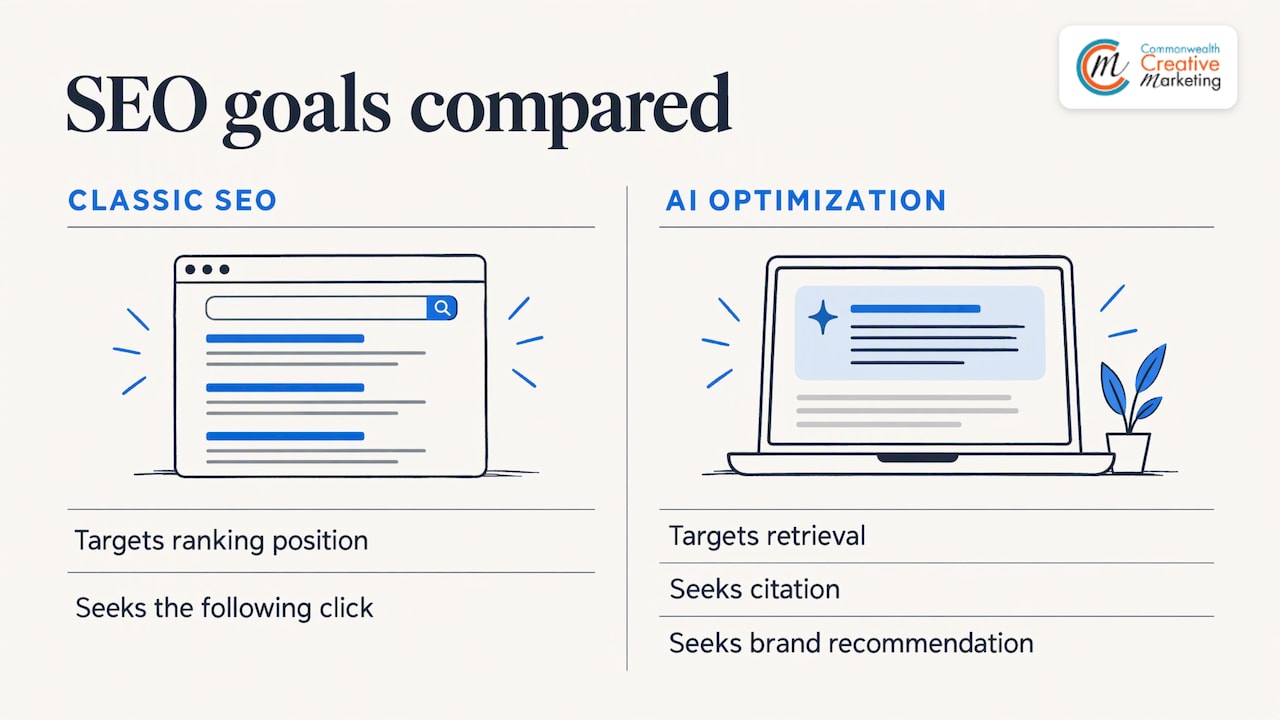
That is why the two disciplines work best together. The same fast, crawlable, well-organized site serves both. The extra layer is making sure the answer-shaped facts about your business are easy to lift.
How AI engines find and cite business content
Understanding the mechanism keeps you from chasing myths. Search Engine Land explains that many AI engines use retrieval-augmented generation: a live retrieval step finds relevant documents, and the answer is then written from those items. That grounding is what makes citations possible.
A 2026 academic study of 158,099 commercial answers adds detail. It found that AI search engines first retrieve pages, then select and cite from that retrieved set. Retrieval explained 32% of the variation in citations, while measured page properties explained 2.8% within a single website. In ChatGPT, every cited page had been retrieved first, and the engine’s rewritten sub-queries mattered most.
For a business owner, three lessons follow:
- You have to be retrieved before you can be cited. If your site is blocked, unindexed or never matches the question, nothing else counts.
- Matching meaning beats tweaking structure. The same study associates matching the engine’s rewritten sub-queries with citations more closely than page properties such as structure or speed. Write pages around the specific questions people ask, in the words they use.
- Rankings do not guarantee visibility. The study cautions against assuming that traditional Google rankings predict AI visibility.
Why results move around
Expect volatility. In the same study, repeated ChatGPT runs on the same day shared only 2.7% of rewritten queries and 15% of cited pages. On average ChatGPT consulted 26 pages and cited 3. A single test, good or bad, tells you little. Look at patterns over weeks, and treat each engine as its own channel.
What to change on a small-business website
The research points to the same short list. None of it needs a large budget, but it does need care and consistency.
Write for the question, not the slogan
Search Engine Land’s guidance is to use clear, factual content under descriptive H2 and H3 headings that directly answer common customer questions, and to skip preamble-heavy marketing language. The U.S. Chamber of Commerce says the same thing from the small-business side: specific, comprehensive information helps AI match long, detailed queries. It recommends concrete details such as specifications, compatibility, availability and relevant photos instead of vague copy.
In practice, that means:
- A page for each service, with the neighborhoods or cities you serve named plainly.
- Real answers to “how much,” “how long,” “what’s included” and “who is this for.” If you publish a price range, state it.
- Sections that stand on their own, so one paragraph can be quoted without the paragraphs around it.
- Fresh content. Update hours, services and pricing when they change.
Keep the door open for crawlers
Semrush reports that AI systems supplement what the model already knows with live web retrieval through their own crawlers and search indexes. Its advice: allow the relevant crawlers, confirm your pages are indexed, answer the intent behind prompts, write self-contained sections and keep content current.
Check three things this week:
- Your robots file and any security or firewall settings are not blocking the crawlers you want.
- Your important pages appear in search results and in Search Console’s indexing report.
- Your key content is present in the page’s HTML, not hidden behind scripts that load it only after the page opens.
Google also lets you manage how your content appears in its AI features. Its guide to AI features and your website is the official starting point for AI Overviews and AI Mode from a site owner’s perspective.
Make your business identity consistent
AI systems build a picture of your business from many places. The same Search Engine Land guidance stresses consistent entity signals that define your brand and offerings. Semrush advises presenting your brand and offerings clearly and consistently on your site and on third-party profiles. For a local company, that means the same business name, address, phone number, service descriptions and hours on your website, Google Business Profile, directories and social profiles.
Keep the SEO foundation
Nothing here cancels the basics: a fast, mobile-friendly site, clean structure, good local listings and reviews. Our SEO services and local search work cover those foundations, because AI visibility rests on them.
A quick checklist you can run in an afternoon
| Check | What “good” looks like |
|---|---|
| Crawler access | Robots settings and firewall do not block the crawlers you want |
| Indexing | Your service and contact pages show as indexed in Search Console |
| Service pages | One page per service, with plain language, location and details |
| Customer questions | The top 10 questions you hear on calls are answered on your site |
| Business details | Name, address, phone and hours match everywhere |
| Freshness | Pricing, hours and services reviewed in the last few months |
| Measurement | Search Console and Google Analytics set up and reporting |
If a row fails, fix it before paying for anything more advanced.
How to measure AI search visibility
Rankings alone no longer tell the story, so measure in layers. One professional guide recommends tracking mentions, citations, referrals and leads or sales separately, because each answers a different question.
- Mentions: Does an AI answer name your business when someone asks about your service in your area?
- Citations: Does it link to your site?
- Referrals: Does identifiable AI traffic reach your pages? Google Analytics can show this.
- Leads and sales: Did those visitors call, fill in a form or buy?
Google has also given site owners a native tool. As of 31 August 2026, Search Console’s Generative AI performance report is available for all websites worldwide, with impression data for AI Overviews and AI Mode. Google’s own guidance suggests pairing Search Console with analytics to track conversions and time spent on your site.
A simple routine works well: once a month, ask the same ten customer-style questions in each AI engine you care about, record which businesses are named, and compare against your Search Console and analytics numbers. Because answers vary from run to run, repeat each question a few times and look at the trend, not a single result.
What generative engine optimization services include
Providers package this work differently, but a credible engagement usually covers the same building blocks:
- An audit of crawler access, indexing, site structure and how your business currently appears in AI answers.
- Content work: service pages, local pages and question-led articles written around what customers actually ask.
- Technical fixes: page speed, clean markup, accessible content.
- Entity and listing cleanup: consistent business details across your site and third-party profiles.
- Reporting: mentions, citations, referrals and leads, reviewed on a regular schedule.
How to evaluate an agency
Use these questions in the first call:
- What exactly will you change on my site, and in what order? You want a plan, not a mystery.
- How will you report progress? Ask for the specific metrics above, plus Search Console data.
- Do you guarantee a position in AI answers? Be cautious if the answer is yes. The research shows results are unstable and engine-specific, so honest providers promise work and measurement, not placement.
- Do you understand my local market? A business competing in Hampton Roads needs local knowledge, not a generic national template.
- Does the work also strengthen regular SEO? It should, since the approaches are complementary.
- Who do I talk to? Responsiveness matters when you are changing live pages.
Also watch for a provider who treats AI visibility as separate from your website. If the site itself is slow, outdated or hard to crawl, the best content strategy has little to stand on.
Our perspective
We work only with small, locally owned businesses in Virginia Beach, and that shapes how we think about AI search. A national brand needs an enterprise platform. A local business needs its website, listings and answers in good order, and a partner who picks up the phone.
Our view is that AI search rewards what good local marketing already does: say clearly what you do, where you do it, and what it costs or involves. We build that into the site first, because the site is the source AI engines retrieve from. Then we add search optimization, local listings and ads around it, so one set of facts supports every channel.
We also think small businesses should not have to buy a separate, expensive program for every new search trend. Our approach is to tailor the work to your goals and budget, communicate often, and measure real calls and leads, not vanity numbers.
Marc
Work with a local team on AI search visibility
If you would rather have this handled, we offer AI search optimization in Virginia Beach as part of our search services, alongside traditional SEO and local search marketing. We do not publish a price for AI search optimization, so we scope it to your business. Our Local Search Marketing plan, which covers local maps, listings and reviews, is $79 per month.

Your website is the foundation. Our web design projects run $1,800 to $3,800, and hosting and site management starts at $55 per month. You can see how we approach AI-focused SEO work in a case study or start on our SEO services page and tell us what you want customers to find.
A word on AI-built sites: tools can produce a page quickly, but a site that is generic, slow or vague gives AI engines little to work with. We explain the trade-offs in AI website builders versus professional builders.
FAQ
Is AI search optimization different from SEO?
It extends SEO. Traditional SEO targets rankings in link-based results, while AI search optimization targets being retrieved, cited and recommended in AI-written answers. The two share most of their foundations, so strong SEO is the best starting point.
What is generative engine optimization?
Generative engine optimization is a sub-discipline of AI search optimization. It focuses on getting your content cited in responses from generative engines such as Google AI Overviews and Perplexity. It is one part of a wider toolbox that also includes technical and local SEO.
Can a small business show up in AI answers without a big budget?
Often the first gains are low-cost: allow relevant crawlers, confirm your pages are indexed, keep business details consistent online, and answer customer questions in clear, self-contained sections. Those steps are the ones Semrush recommends for U.S. businesses. Ongoing content and listing work adds to them over time.
How do I know if it is working?
Track mentions, citations, referrals and leads separately. Use Search Console’s Generative AI performance report for impressions and Google Analytics for traffic and conversions. Because AI answers change between runs, judge progress over several months.
Can anyone guarantee I will be cited?
No. Engines choose from the pages they retrieve, and the same question can produce different sources from one run to the next. What a provider can promise is a clear plan, better pages and honest reporting.
Sources
- What Is AI SEO? How Artificial Intelligence Is Changing Search (Search Engine Land)
- SEO vs. GEO, AIO, LLMO: What marketers need to know (Search Engine Land)
- How different AI engines generate and cite answers (Search Engine Land)
- What Drives AI Citations? Content, Retrieval and Model (arXiv)
- How small businesses can stand out in the age of AI-powered search (U.S. Chamber of Commerce)
- Where does AI get its information? And how to get cited (Semrush)
- How to Improve Brand Visibility in AI Answer Engines (business.com)
- Generative AI performance report (Google Search Console Help)
- AI features and your website (Google Search Central)