

A website generates leads when every page gives a visitor one clear next step, asks for only the information you need, and is fed by traffic from search, maps and paid ads that match what people are looking for. At Commonwealth Creative Marketing in Virginia Beach, we build sites with that job in mind, so the design, hosting, local search and ads all point at the same goal: a phone call or a form from a real customer.
This guide is for owners of local shops and service businesses. It covers what a lead-generating site needs, the cheap fixes that lift inquiries, how online ads fit in, and how to tell good leads from noise.
Key Takeaways
- A lead is a person who has raised a hand: a form, a call, a booking. A site that only looks good gives visitors nothing to raise a hand with.
- Give each page one primary call to action, and keep forms short. Every extra field costs you completed forms.
- Traffic and conversion work together. Local search and Google Ads send people, and the page decides whether they become inquiries.
- Measure leads, not clicks. Track calls and form submissions, then connect them to the jobs you actually win.
- Small sites can start affordably: a focused website, steady hosting and care, and one traffic channel at a time.
Table of Contents
- What website lead generation actually means
- The pages and elements a lead-generating site needs
- Keep forms short: the cheapest fix with the biggest effect
- Make it easy on mobile
- Offer something for visitors who are not ready yet
- Getting traffic: search, maps and ads
- How to get more conversions from Google Ads
- Measure lead quality, not just lead count
- What it costs to build a site that generates leads
- Our perspective
- Put a lead-generating site to work for your business
- FAQ
- Sources
What website lead generation actually means
A lead is someone who has shown interest in what you sell and given you a way to reach them. For a plumber, that is a call or a quote request. For a boutique, it might be an email signup for a sale. For a consultant, a booked discovery call.
Website lead generation is the system that produces those people: visitors arrive, see a reason to act, and act. It has two halves, and most disappointing websites are missing one of them.
- Traffic: the right people finding you, through search results, map listings, ads or referrals.
- Conversion: the site turning a share of those visitors into inquiries.
A beautiful site with no traffic produces nothing. A busy site with confusing pages leaks the visitors you paid to get. The sections below take the conversion half first, because fixing it makes every dollar of traffic work harder.
The pages and elements a lead-generating site needs
You do not need a giant site. You need a small set of pages that each do one job.
The homepage: say what you do and give one action
Visitors decide in seconds whether they are in the right place. Put a plain headline that names your service and your area, a short line on why you, and one prominent button above the fold, meaning visible without scrolling. HubSpot’s guidance on landing pages recommends a clear headline, short description, benefit bullets and a strong button, with nothing that distracts the visitor from the next step.
Service pages: one page per thing you sell
If you do web design and also printing, give each its own page. Someone searching for a service wants a page about exactly that. Each service page should explain what is included, show proof such as photos or reviews, and end with the same single call to action. Mixing three offers and four buttons on one page is the most common reason visitors leave without acting.
The contact page: a form, not just an email address
Someone on your contact page is already close to buying. Make it easy. Use a short form, put your phone number where it can be tapped on a phone, and tell visitors what happens after they submit, for example when you will reply. A form also lets you capture the details you need up front, which a bare email link does not.
Proof: reviews, photos and local detail
Trust signals do quiet work. Customer reviews, photos of finished jobs, logos of local organizations you belong to, your address and service area all tell a nervous visitor that you are real. A local business has an advantage here that national brands cannot copy: you can name the neighborhoods you serve and show work they recognize.
A thank-you page
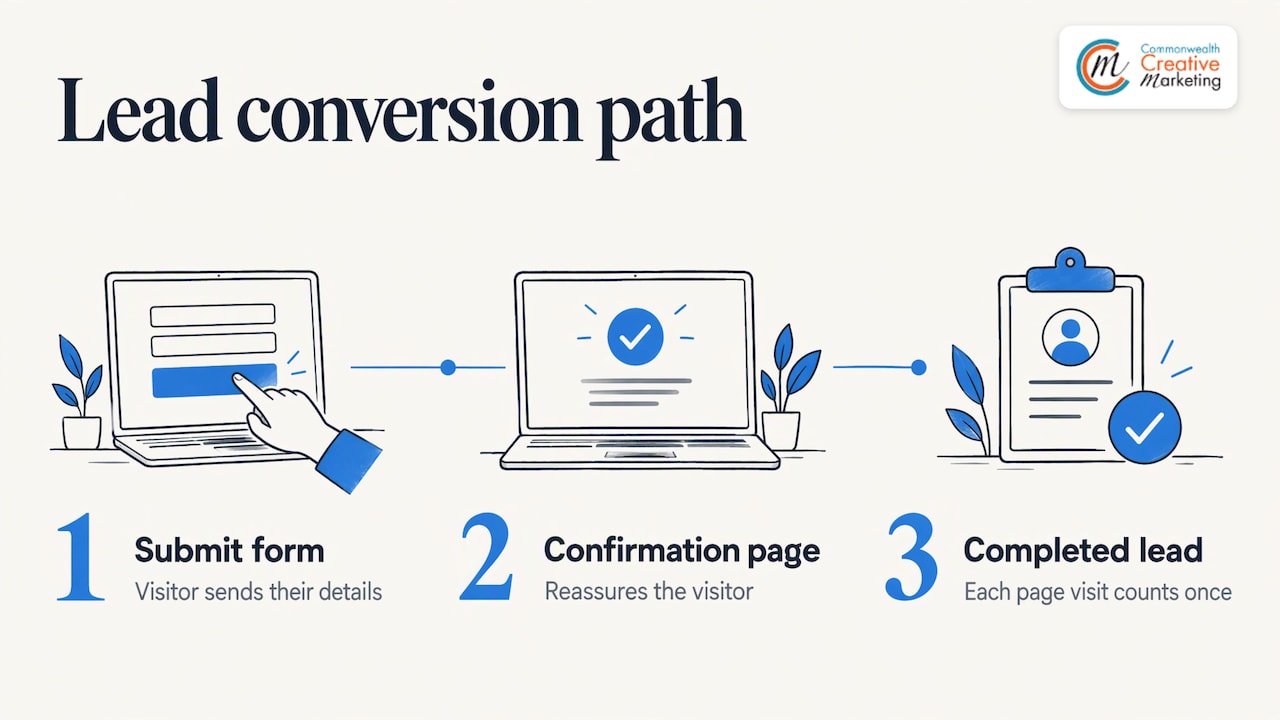
Send people to a confirmation page after they submit. It reassures them, and it gives you a clean way to count conversions, because every visit to that page is one completed lead.
Keep forms short: the cheapest fix with the biggest effect
The single most affordable improvement on most small business sites is trimming the form. The Better Business Bureau advises collecting only the most relevant information, such as a first name and an email, and notes that asking for too much up front is a leading reason consumers distrust a brand (BBB Business Tip on capturing leads).
A practical rule for service businesses:
| Field | Keep it? | Why |
|---|---|---|
| Name | Yes | You need to know who to call back |
| Email or phone (one required) | Yes | You need a way to reply; let people pick |
| What do you need? (short message) | Yes | Lets you qualify the request |
| Company size, budget, address | Usually no | Ask on the first call instead |
| Phone number on a newsletter form | No | Raises friction for little gain |
HubSpot’s team reported that removing the phone number field from a form made completed submissions jump almost overnight, because the audience did not want to share a number unless it was necessary (HubSpot on lead generation websites). The lesson is not that phone numbers are bad. It is that every field must earn its place. If your sales process depends on a call, keep the phone field. If you can follow up by email, drop it.
Make it easy on mobile
Many local searches happen on a phone, often by someone who wants to call or get directions now. The BBB lists a mobile-friendly page and a clear call-to-action button among its basic steps for converting visitors (BBB). Check your own site on your phone:
- Can you tap the phone number to call?
- Is the form usable with a thumb, without zooming?
- Does the page load quickly on a cellular connection?
- Is the main button visible without scrolling?
If any answer is no, that is where leads are leaking. Our responsive web design and mobile website design pages explain how we build sites that work on every screen size.
Offer something for visitors who are not ready yet
Not everyone who visits is ready to book. A short checklist, a seasonal guide, or a newsletter signup captures people who are interested but still comparing. Keep it matched to what you sell: a landscaper might offer a seasonal lawn care checklist, a restaurant a mailing list for event announcements. A lead magnet only works if it attracts the people who would eventually buy from you, not anyone who likes free things.
On-page tools can help too. A simple chat prompt or a scheduling link means a visitor can act at 9 p.m. without waiting for business hours, and it saves you rounds of phone tag.
Getting traffic: search, maps and ads
Once the site converts, send it people who want what you sell.
Local search and map listings
For a business serving Virginia Beach, Norfolk and the rest of Hampton Roads, the most valuable visitors are the people searching for your service in your area. Accurate listings, a maps profile, reviews and local content put you in front of them at the moment they are ready to act. Our Local Search Marketing plan is $79 per month, and our guide on improving your local web presence walks through the basics.
Being found in AI answers
More people now ask AI tools for local recommendations. Answer engine optimization (AEO) is the work of making your business easy for those tools to understand and cite. We cover it in how small businesses get cited, and our AEO plan runs $1,150 to $2,000 per month.
Online advertising for lead generation
Ads buy traffic immediately, which suits a business that needs inquiries now rather than in six months. Google’s own guidance says Google Ads can generate leads through call assets, which let people phone you straight from the ad, and lead form assets, which collect their details without leaving Google (Google, best practices for high-quality leads).
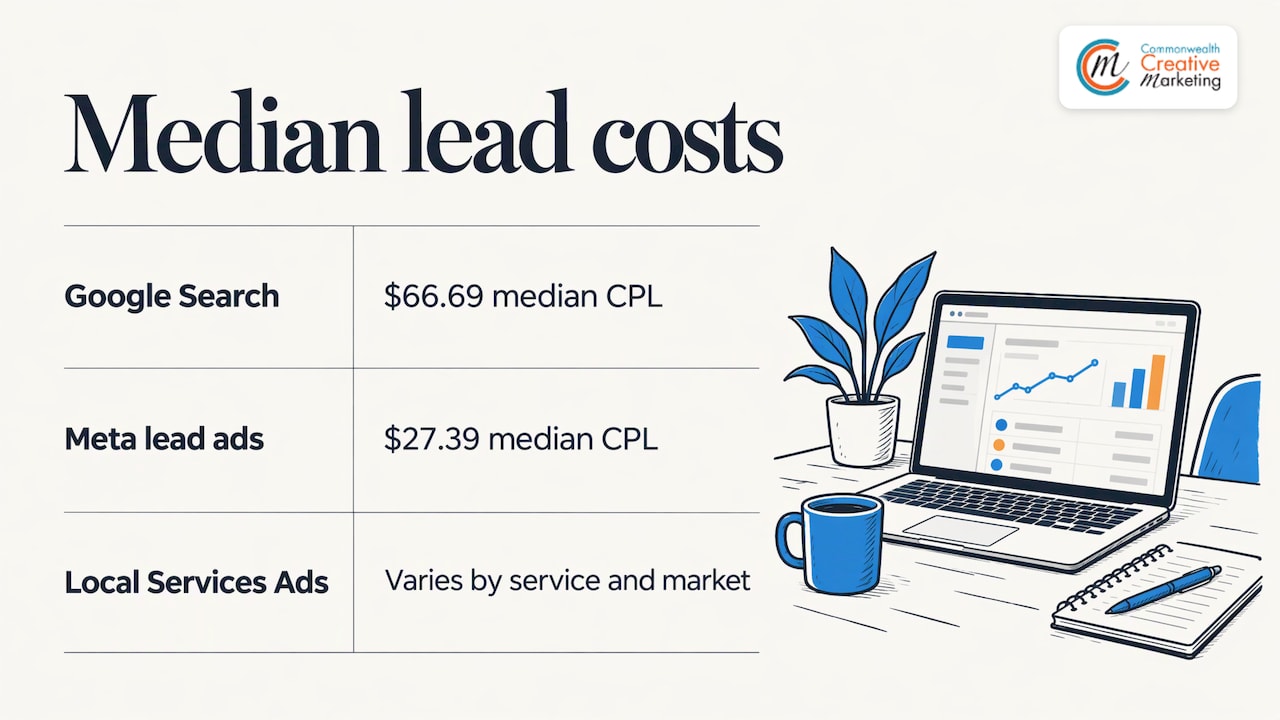
What will a lead cost? Nextiva’s November 2026 roundup of small business advertising reports a median cost per lead of $66.69 for Google Search ads and $27.39 for Meta lead ads, while Google Local Services Ads charge per lead at rates that vary by service and market (Nextiva). Those are medians across many advertisers, so your own cost will depend on your trade, your competition and your landing page. They are useful mainly for judging whether a lead is worth it to you: if a typical job earns you several hundred dollars, a lead in this range can pay for itself.
If you want the detail, our guides on Google Ads for small business and how much to spend on Google Ads cover budgets and setup, and the five key elements of a pay per click campaign lists what every campaign needs.
How to get more conversions from Google Ads
Clicks cost money whether or not they turn into inquiries, so improving paid search leads is mostly about relevance:
- Match the ad to the page. Someone who clicks an ad for emergency AC repair should land on a page about emergency AC repair, not your homepage.
- Start narrow. Search Engine Land’s advice for small businesses is a focused campaign with a few single-keyword ad groups on exact match keywords, which keeps search terms, ads and landing pages closely relevant and supports higher quality scores (Search Engine Land).
- Make the next step obvious. One button, one short form, one phone number.
- Count the right thing. Tell Google what a lead is on your site, a form submission or a call, so it can optimize for those results instead of clicks.
- Follow up on visitors who left. Retargeting shows your ads again to people who visited but did not inquire.
Our Google Ads management page describes how we run campaigns for local businesses, and what to expect from a Google Ads agency explains the working relationship.
Measure lead quality, not just lead count
Ten inquiries from people who will never buy are worth less than three from people who will. Google’s guidance frames success around choosing the right conversion goals across the whole path from lead to sale, and building a measurement foundation with the Google tag plus enhanced conversions or offline conversion imports (Google). In plain terms:
- Count form submissions and calls separately, so you know which one brings the better customers.
- Record where each lead came from: search, maps, an ad, a referral.
- Note which leads became paying jobs, even in a simple spreadsheet.
- Divide your ad spend by paying customers, not by clicks.
After a month or two, you will see which source is worth more budget and which page needs work. Change one thing at a time, such as the headline, the button wording or the number of form fields, so you know what moved the result.
What it costs to build a site that generates leads
You do not need an enterprise budget. A sensible path for a small business is to start with a focused site, keep it healthy, then add one traffic channel at a time.
| Step | What it is | Our published price |
|---|---|---|
| Website | Custom design built around calls and forms | $1,800 to $4,800, one-off |
| Hosting and care | Hosting and site management | From $55 per month |
| Local visibility | Local search marketing | $79 per month |
| AI search | AEO | $1,150 to $2,000 per month |
| Paid traffic | Google Ads and Facebook Ads | Quoted per business |
Site upkeep matters for lead generation because a form that silently breaks or a page that goes down costs inquiries you never see. See what website maintenance services include and how our hosting works.
Our perspective
Most small business owners we meet do not have a traffic problem first. They have a site that was built to look good and never given a job. We start by asking what a customer should do on each page, and we design backwards from that.
We work only with small, locally owned businesses in Virginia Beach, so we can pair digital work with the tools local owners also use: search, ads, print, vehicle graphics and billboards. A van wrap, a flyer and a Google ad can all send people to the same page, and that page should be ready for them.
Our advice is to get the foundation right first: a clear site, short forms, a number people can tap. Then add local search, then ads, and measure each one against real customers. Affordable marketing is not the cheapest marketing. It is marketing where you can see what each dollar did.
Marc
Put a lead-generating site to work for your business
If your current site looks fine but the phone is quiet, the fix is usually in the structure: the pages, the call to action, the form and the traffic behind them. We design and manage websites for Virginia Beach small businesses, from the first page through hosting, local search and advertising, so each piece supports the same goal. Take a look at our website design services, starting at $1,800, or contact us to talk through what your business needs.

FAQ
How can a website generate leads?
Give visitors a clear action on every page, such as a call button, a short quote form or a booking link, and bring in people who are actively searching for your service. Local search, map listings and ads supply the traffic, and the site converts it. A confirmation page lets you count each completed inquiry.
How much should I pay for lead generation?
It depends on the channel and your trade. Nextiva’s November 2026 benchmarks put the median cost per lead at $66.69 for Google Search ads and $27.39 for Meta lead ads. Compare any figure with what a new customer is worth to you. Our Local Search Marketing plan is $79 per month, and ad management is quoted per business.
How many fields should a lead form have?
As few as you need to follow up: usually a name, one way to reach the person, and a short message. The BBB notes that asking for too much information up front is a leading reason people distrust a brand.
How do I increase Google Ads conversions?
Send each ad to a page about exactly what it promised, start with a small set of tightly matched keywords, and make the next step obvious. Then track calls and form submissions as conversions so your campaign optimizes for inquiries instead of clicks.
Sources
- BBB Business Tip: How to capture more leads with your website
- How to Create a Lead Generation Website, HubSpot
- Best practices for generating high-quality leads, Google
- Small Business Advertising Ideas, Nextiva
- Google Ads for SMBs: How to maximize paid search success, Search Engine Land