

Local SEO for contractors means making your business show up when homeowners and property managers near you search for the work you do. The core moves are a complete Google Business Profile, a website with a page for each service and each city you serve, steady customer reviews, and consistent listings. Do those four well and you will be visible in the map results and in regular search, right when someone needs a roofer, plumber or remodeler.
This guide walks through each piece in the order we would tackle it, what to handle yourself, and where outside help pays for itself.
Key Takeaways
- Local search rankings come down to relevance, distance and prominence. You cannot move your address, so put your effort into relevance and prominence.
- Your Google Business Profile is the first thing to fix: accurate details, the right services, photos, posts and a steady flow of reviews.
- Every core service and every city you serve deserves its own page on your website, with a unique URL, clear contact details and a call to action.
- Target buyer-intent searches such as “bathroom remodeler near me” rather than broad informational terms.
- Track calls, form fills and direction requests, not just rankings, and review them monthly.
Table of Contents
- What local SEO means for a contractor
- Step 1: Build out your Google Business Profile
- Step 2: Choose keywords that bring buyers
- Step 3: Make your website do the work
- Step 4: Earn reviews and keep your listings consistent
- What does local SEO cost, and is it worth it?
- How to measure results and decide what to do yourself
- Get help with local search in Virginia Beach
- FAQ
- Sources
What local SEO means for a contractor
Local SEO is a strategy for making a service business more visible in search within a specific geographic area. Jobber’s guide for service businesses separates it from general SEO by that focus on a defined area, and it recommends pairing a service term with a location modifier, such as a city name or “near me.”
For a contractor this is the whole game. A homeowner with a leaking roof does not want the best roofer in the country. They want one who can show up this week. Searches like that trigger the map pack, the group of three or so businesses shown above the regular results, and those listings draw a large share of the calls.
The three factors behind local rankings
Google ranks local results on three main factors, as SimplyWise’s 2026 contractor guide explains: relevance (how well your profile matches the search), distance (how far you are from the searcher) and prominence (how well known you are).
The same guide makes a useful point: you cannot relocate your shop, and you can only partly influence distance through service-area settings. Relevance and prominence are fully in your hands. Everything below is aimed at those two.
| Factor | What it means | What you control |
|---|---|---|
| Relevance | How well your listing and site match the search | Categories, services, page content, keywords |
| Distance | How close you are to the searcher | Service-area settings, accurate address |
| Prominence | How well known and trusted you are | Reviews, listings, local links, mentions |
Step 1: Build out your Google Business Profile
Start here, because it costs nothing and drives the most calls. Search Engine Land’s contractor guide recommends creating or claiming a free Google Business Profile and filling in your business name, address, phone number, opening hours, posts and reviews.
A practical checklist:
- Use your real business name. No extra keywords stuffed in. It can get a listing suspended.
- Choose a primary category that matches your main trade, then add secondary categories for related work.
- List every service you offer, with short plain descriptions. Separate “water heater replacement” from “drain cleaning” instead of one blob.
- Set your service area to the cities and neighborhoods you actually work in.
- Add real photos of finished jobs, your crew and your truck. Stock images add nothing.
- Post updates such as a completed project or a seasonal reminder, and keep the hours current, including holiday hours.
If you want a deeper walkthrough, we cover how to improve Google Business Profile rankings for Virginia Beach businesses in a separate guide.
Step 2: Choose keywords that bring buyers
Search Engine Land’s contractor guide describes four kinds of search intent: navigational, informational, commercial and transactional. For a contractor, the money sits in commercial and transactional searches, such as “bathroom remodeler near me” or “best general contractors in New York.” Someone typing those is comparing or ready to hire.
Build a short keyword list from three parts:
- The service: roof replacement, panel upgrade, deck building, kitchen remodel.
- The place: your city, the neighboring cities, and well-known neighborhoods.
- The urgency or qualifier: emergency, licensed, free estimate, same day, if they honestly apply to you.
For example, a Virginia Beach fence company would aim at phrases like “fence installation Virginia Beach” and “vinyl fence contractor Chesapeake.” Do not chase a hundred terms. Pick the ten services that make you the most profit and the cities where you want more jobs.
Step 3: Make your website do the work
Your profile gets the click. Your website closes the deal. Three things matter most.
One page per service
A single “Services” page that lists everything in a paragraph cannot rank for each trade you offer. Give each major service its own page with a clear explanation of the work, your process, typical project types, photos and a way to request a quote.
Service-area pages for each city
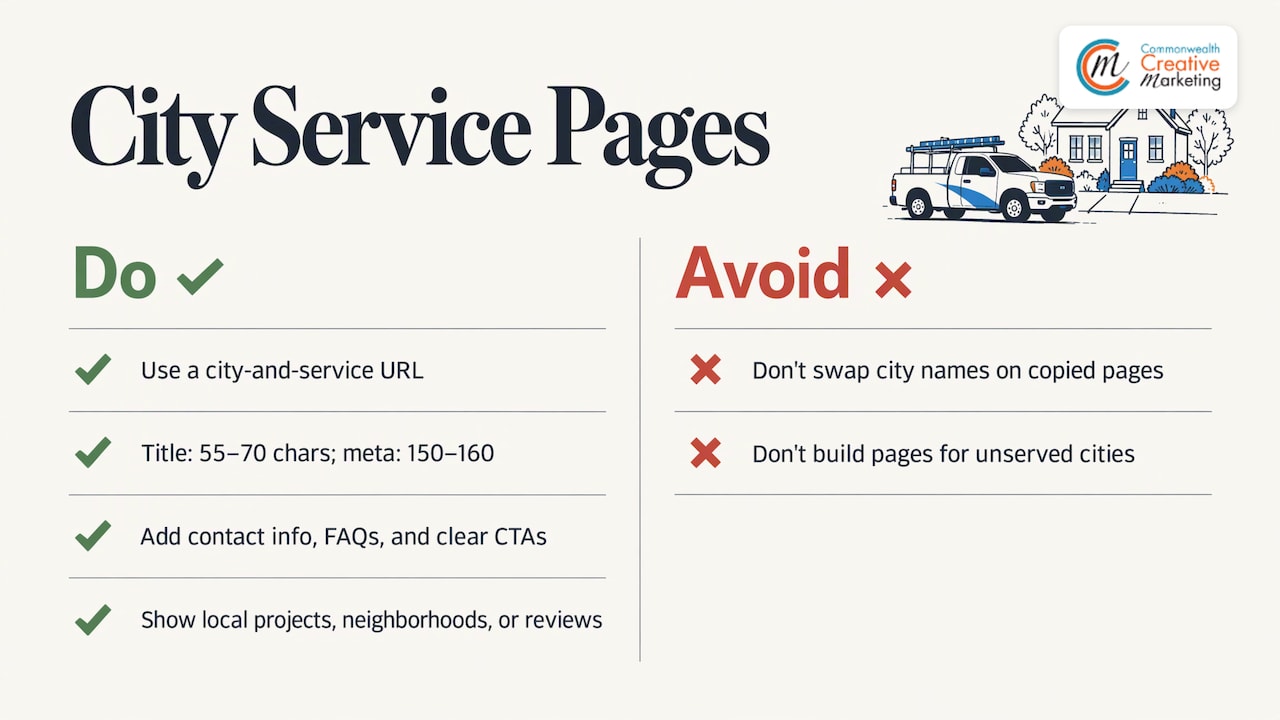
Search Engine Land’s service area pages guide recommends a unique URL for each landing page that includes the city name and the core service. It also suggests title tags of 55 to 70 characters, meta descriptions of about 150 to 160 characters, and on every page complete contact information, customer-focused language, FAQ answers and clear calls to action.
The trap is copying one page and swapping the city name. Make each page genuinely local: projects you completed there, neighborhoods or housing styles you know, permit or weather issues that matter in that city, and reviews from customers there. If you have not worked in a city, do not build a page for it.
Speed, mobile and click-to-call
Most local searches happen on a phone, often in a moment of need. Your site should load quickly, read well on a small screen and put a tap-to-call button at the top. A site that is hard to use on mobile loses the job even when you rank well. Our responsive website design work is built around exactly that.
Fresh content helps too. Project write-ups, seasonal maintenance tips and answers to the questions customers ask on estimates all give your pages more to rank on. See our notes on content improvements that can boost local SEO.
Step 4: Earn reviews and keep your listings consistent
Prominence is mostly reviews, listings and mentions from other local sources.
Reviews
Ask every satisfied customer for a Google review while the job is fresh. Search Engine Land’s contractor guide lists asking for reviews as part of the Google profile work. Make it easy: text the direct review link when you finish, and ask the crew lead to mention it at handoff. Reply to every review, positive or negative, politely and specifically. Replies show future customers how you handle problems.

Directories and listings
The same guide recommends local directories such as Yelp, Yellow Pages, Bing Places and Angi to reach customers outside Google Search. That also answers a common question: yes, Yelp can be worth claiming for contractors, as a complement to Google rather than a replacement. Use the same business name, address and phone number everywhere, written the same way. Inconsistent details confuse both customers and search engines.
Local links and mentions
Links from local sources tell search engines you are a real, established business in the area. Good ones are realistic for a contractor:
- Your local chamber of commerce or business association
- Suppliers and manufacturers whose products you install
- Sponsorships of youth teams or community events
- Local news coverage of a notable project
- Partner trades, such as a builder and a landscaper referring each other
What does local SEO cost, and is it worth it?
Prices vary widely by market, competition and how much of the work you hand off. Rather than quote a national average, here is what we publish for local businesses in Virginia Beach:
| Service | Our published price |
|---|---|
| Local Search Marketing | $79 per month |
| Website Design | $1,800 to $4,800, one-off |
| Hosting & Site Management | from $55 per month |
| AEO (answer engine optimization) | $1,150 to $2,000 per month |
Whether it is worth it comes down to arithmetic you can do yourself. Take your average job value, multiply by the share of inquiries you close, and compare that with what a single extra job per month adds. For most contractors with a decent ticket size, a handful of extra calls from the map pack justifies a modest monthly investment. Local SEO builds over months, so it suits a business that wants a steady pipeline. If you need leads this week, paid search can run alongside it. Our Google Ads for small business guide explains how.
How to measure results and decide what to do yourself
Rankings are a vanity number if the phone does not ring. Track these each month:
- Calls from your Google Business Profile and from the website
- Direction requests and website clicks shown in your profile insights
- Form submissions and quote requests
- Where each new customer heard of you. Ask on every first call.
- Review count and average rating
Keep a simple spreadsheet with one row per month. After three to six months you will see which pages and profile changes line up with more jobs.
What most owners can handle in-house
Claiming and filling out your profile, asking for reviews, answering review replies, posting job photos and keeping hours accurate are all doable in an hour or two a week. Write those into a routine and assign them to one person.
Where a local partner saves time
Service-area page strategy, technical website fixes, listing cleanup across dozens of directories, link outreach and reporting take specialist time most contractors would rather spend on job sites. That is where a team that does this daily earns its fee. See our small business SEO guide for how we think about splitting the work.
Our perspective on contractor SEO
We work only with small, locally owned businesses in Virginia Beach, and contractors are some of the clearest examples of who local search was made for. Your customers are within a short drive, they search at the moment of need, and they pick from the first few names they see.
What we see again and again is that the businesses that win are not the ones with the biggest budgets. They have a complete profile, a website with real pages for real services, and reviews that keep coming. Our approach is to combine digital work with the traditional advertising a local contractor already uses: the truck wrap, the yard sign, the direct mailer. When those point to the same strong online presence, each one works harder.
We design every site to fit the business rather than a template, and we keep communication quick, because a contractor cannot wait a week for an answer about a broken contact form.
Marc
Get help with local search in Virginia Beach
If you would rather spend your week on jobs than on listings and landing pages, our team handles it for Virginia Beach and Hampton Roads businesses. Our Local Search Marketing plan is $79 per month and covers local maps, listings and reviews, and we can build or rebuild the website those searches land on.

See our SEO services or contact us through our site to talk through what your trade needs.
FAQ
What is SEO for contractors?
It is the work of making your business appear in search results when people near you look for your trade. It covers your Google Business Profile, your website’s service and city pages, reviews and local listings. The goal is more calls and quote requests from your service area.
Does Yelp work for contractors?
It can help as one of several listings. Search Engine Land’s contractor guide recommends Yelp, along with directories like Bing Places and Angi, to reach people outside Google Search. Claim the listing, keep your details identical to your other profiles, and keep Google as your main focus.
Is local SEO worth it for a service business?
For most contractors, yes, because customers search locally at the moment they need to hire. Compare your average job value with the cost of a monthly plan: if a few extra jobs a year cover the fee, it pays off. Results build over months, so give it time.
Can I do local SEO myself?
The basics, such as your Google profile, review requests and photos, are manageable for an owner with a few spare hours each week. Page structure, technical fixes and listing cleanup go faster with a specialist. Many contractors split the work that way.
Sources
- How to Attract More Customers with Local SEO (Jobber)
- Local SEO for Contractors: Rank Higher and Book More Jobs (SimplyWise)
- How to do SEO for contractors (Search Engine Land)
- Service Area Pages: Boost Local SEO Across Locations (Search Engine Land)