

Ecommerce SEO services improve how your online store ranks in organic search, so more shoppers find your category and product pages without you paying for each click. A good engagement starts with an audit, fixes technical and structural problems, optimizes product and category pages, builds content and links, and reports on sales rather than just rankings. Below is what each piece involves, what providers charge, and how a small store can tell a solid proposal from a vague one.
Key takeaways
- Ecommerce SEO is ordinary SEO applied to a catalog: the same crawling and indexing, with extra weight on category pages, product pages, structured data and site structure.
- Start with an audit. It tells you what is broken before you pay for months of ongoing work.
- Link building helps only when the links are earned or placed editorially. Paid link schemes can get a store suppressed in results.
- Published US pricing runs from the low hundreds to $10,000 or more per month, so ask for scope and deliverables, not just a number.
- Judge any agency on revenue, orders and organic traffic to money pages, not on keyword rankings alone.
Table of Contents
- What ecommerce SEO actually is
- What ecommerce SEO services usually include
- The three types of SEO and how they apply to a store
- What an SEO audit covers and how to use it
- Link building: what is legitimate and what is not
- What ecommerce SEO services cost
- Is SEO worth it for ecommerce?
- How to assess an ecommerce SEO agency
- Our perspective
- How we can help
- FAQ
- Sources
What ecommerce SEO actually is
Google says it crawls and indexes ecommerce sites the same way it handles other websites, then applies algorithms to understand their content and intent. So there is no secret second rulebook for stores. SEO, as Google’s own starter guide frames it, is about helping search engines understand your content and helping people find it and decide whether to visit.
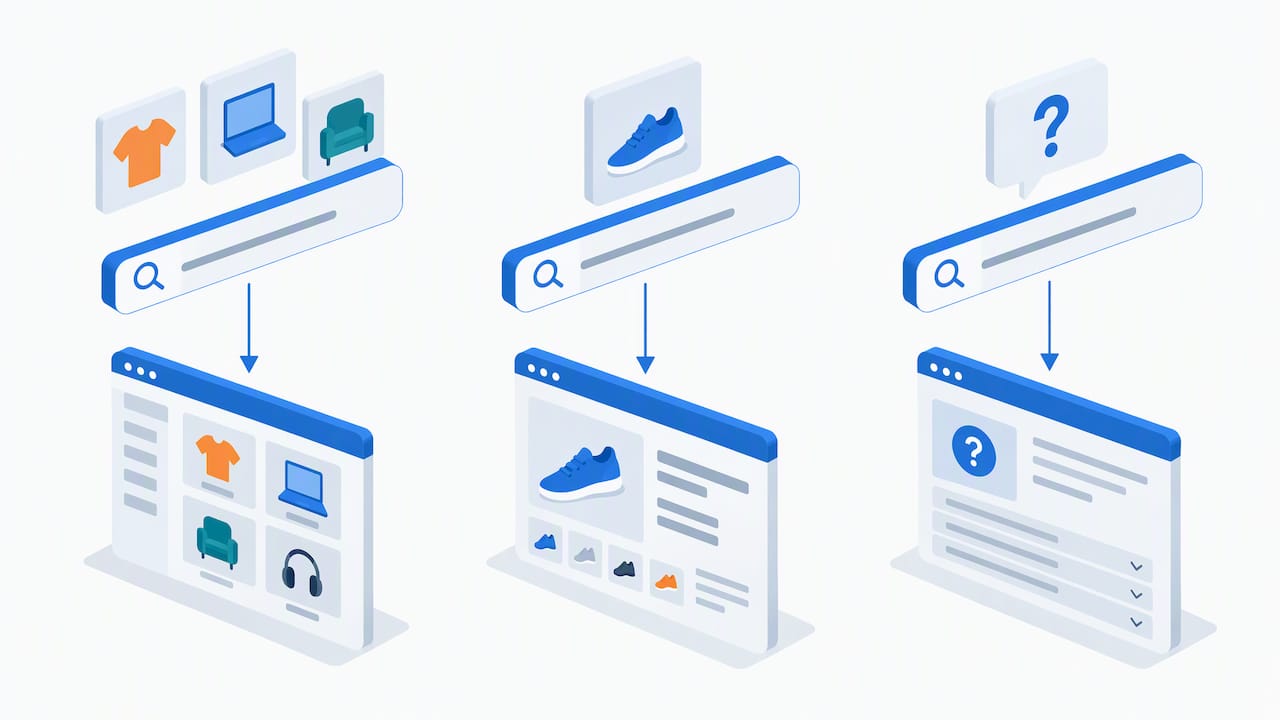
What changes is where the work concentrates. Category and product pages tend to be a store’s most lucrative pages, which is why ecommerce guides put them first. A store also has hundreds or thousands of near-similar URLs, filters, variants and out-of-stock items. A blog-style business site rarely has those problems.
The queries shoppers type matter too. Commercial and transactional searches sit closer to purchase, and Semrush notes that they deserve special attention in an online store. Someone searching “waterproof hiking boots women’s size 8” is much nearer a purchase than someone searching “how to waterproof boots”.
What ecommerce SEO services usually include
Proposals differ in wording, but the work falls into a handful of buckets. Here is what a reasonable scope covers and why each part matters.
Keyword research and page mapping
Every product line and category should target a clear set of searches, and no two pages should compete for the same one. Keyword research for a store covers the broad category terms, the specific product and model terms, and the questions buyers ask before purchasing. The output is a map: this keyword belongs on this page.
Technical clean-up
This is the layer shoppers never see: crawl errors, duplicate URLs from filters and sorting, slow templates, broken redirects after a replatform, and sitemaps that list the wrong pages. Google recommends descriptive URLs, logical organization and sitemaps where appropriate, and says organization becomes particularly relevant once a site passes a few thousand URLs. If you want to know what this layer covers and costs in detail, see our guide to technical SEO services.
Product and category page optimization
Titles, headings, descriptions, internal links, images and unique copy all belong here. Manufacturer descriptions copied onto fifty other stores give Google little reason to prefer yours. Category pages need a short, useful intro, clear subcategories and links to your best sellers. This is the core of onsite optimization.
Structured data
Google says structured data gives explicit clues about what a page means and can make it eligible for richer results. For stores, the relevant types include Product, ProductGroup, Review, BreadcrumbList, Organization and LocalBusiness. Product markup can make price, availability, review ratings and shipping details eligible to appear in Search, Images and Lens.
One detail separates careful providers from careless ones. Google’s merchant-listing guidance is for pages where shoppers can buy, and it recommends putting this markup on individual product pages rather than on category listings. If a proposal says “add product schema everywhere”, ask why.
Content that supports buying decisions
Buying guides, comparison pages, sizing charts and care instructions answer questions that product pages cannot. They also give other sites something worth linking to. Regular publishing on your own site is covered in our piece on blogging for SEO with WordPress.
Links and reporting
Backlinks remain a common part of ecommerce SEO work, and we cover them in their own section below. Reporting should arrive monthly and tie back to orders and revenue.
The three types of SEO and how they apply to a store
People often ask for the three types of SEO services. The usual split is technical, on-page and off-page, and each maps neatly onto a store.
| Type | What it covers | Ecommerce example |
|---|---|---|
| Technical SEO | Crawling, indexing, speed, URL structure, structured data | Fixing duplicate filter URLs, adding product markup |
| On-page SEO | Content, titles, headings, internal links, images | Rewriting thin product descriptions, improving category intros |
| Off-page SEO | Links and mentions from other sites | Getting a supplier, local publication or review site to link to you |
A service that offers only one of the three will leave gaps. A store with perfect product copy but a broken crawl path will not get far, and a technically perfect store with nothing worth linking to will stall.
What an SEO audit covers and how to use it
An audit is a diagnosis. A full one generally covers technical health, content, backlinks, search features and AI visibility, usually with crawling and analytics tools feeding each part.
For a store, a useful audit report should tell you:
- Which pages Google can and cannot reach, and which of those matter for revenue.
- Where duplicate or near-duplicate pages split your ranking power.
- Which category and product pages have thin or copied content.
- Whether structured data is present, valid and placed on the right pages.
- How your backlink profile compares with the stores you actually compete against.
- A ranked list of fixes, ordered by likely impact and effort.
The last item is the one that matters. A 90-page PDF of warnings with no priorities is not an audit, it is a tool export. Ask to see a sample report before you buy.
Audits are usually priced as a one-time fee. Forbes Advisor reported in January 2024 that audits can range from $500 for a simple backlink check to $30,000 for a full content audit. For a small store, the sensible scope is a technical and content review of your main category and product pages, not a deep dive into every URL.
Link building: what is legitimate and what is not
Links from relevant, trusted sites help search engines understand that your store is worth surfacing. A link building service should earn those links through useful content, supplier and manufacturer listings, local sponsorships, press mentions and partnerships.
The risk is on the other side. Google’s spam policies treat link schemes meant to manipulate rankings as spam, which can lead to algorithmic suppression or manual action. Avoid any provider that:
- Guarantees a set number of links per month regardless of quality.
- Sells links on networks of sites that exist only to sell links.
- Cannot show you the actual pages where your links will appear.
- Uses automated comment or forum posting.
A fair test: would the linking page make sense and be worth reading if search engines did not exist? If yes, the link is probably fine. Our own approach to link building is built around quality backlinking rather than volume.
What ecommerce SEO services cost
Costs vary widely with catalog size and competition. Forbes Advisor reports that SEO providers may charge from the low hundreds of dollars to $10,000 or more per month depending on business needs, and that content specialists may charge $0.20 to $2 per word. Those are national figures across all business types, not a quote for any one store.
What drives the price up:
- Large catalogs with thousands of SKUs and variants.
- Heavy technical debt, such as a recent migration or messy faceted navigation.
- Competitive categories where you need a lot of new content and links.
- Multiple storefronts or international versions.
What keeps it manageable for a small store: a focused catalog, a clean platform, and a plan that goes after the 20 or 30 pages that earn the most revenue first.
Is SEO worth it for ecommerce?
For most stores, yes, with a caveat about patience. Organic traffic does not carry a per-click charge, so the cost per sale can fall as pages mature, while paid ads stop the moment you stop paying. But SEO takes months to show results, and no honest provider can promise a ranking or a date.
Set expectations around leading and lagging measures. Early on, look for crawl errors falling, more pages indexed correctly, and impressions rising in Google Search Console. Later, look for organic sessions to category and product pages, orders from organic search, and revenue per organic visit. If an agency reports only on rankings for brand-name searches, they are showing you traffic you would have received anyway.
Many small stores pair SEO with a modest paid campaign while organic pages mature. Our Google Ads management covers that side, and the two share keyword research.
How to assess an ecommerce SEO agency
When you compare proposals, check these points.
- Scope in writing. What gets done each month: pages optimized, content pieces, links, reports.
- A sample audit or report. If they cannot show one, treat it as a warning sign.
- Platform knowledge. Shopify, WooCommerce, BigCommerce and custom builds each have their own quirks with URLs, filters and templates.
- Relevant examples. Ask for client stories in your size range, and ask what changed and over what period. You can browse some of ours in our SEO portfolio.
- Clear ownership. You should own your accounts, analytics and content. Month-to-month terms after an initial period are a good sign.
- No guarantees of position one. Nobody controls Google’s results.
- Who you talk to. A named contact who answers email is worth more than a polished pitch deck.
Our perspective
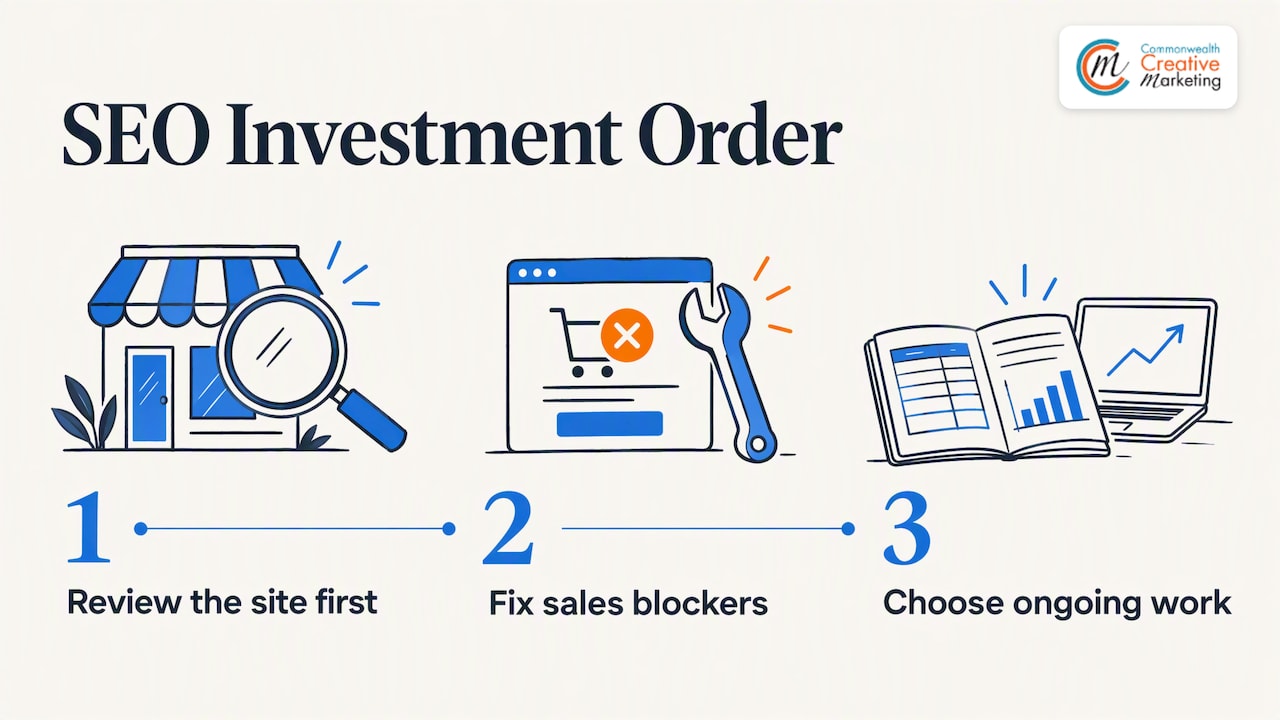
We work with small, locally owned businesses in Virginia Beach and Hampton Roads, and the pattern we see is consistent: owners are sold a big monthly retainer before anyone looks at their site. We think the order should be reversed. Look at the site first, fix what is blocking sales, then decide what ongoing work is worth paying for.
We also believe SEO works best when it is tied to the rest of your marketing. A store with a fast, well-built site converts the traffic it earns. A store whose search listings, Google Business Profile and ads all tell the same story earns more trust. That is why we handle design, hosting, search and advertising under one roof, and why we pay close attention to responsiveness and clear communication with our clients.
If a store has a local presence, such as a showroom, pickup counter or delivery area, local search is often the fastest gain. It is also cheaper to start with than a full national ecommerce campaign.
— User
How we can help
Commonwealth Creative Marketing builds and promotes sites for small businesses in Virginia Beach. If your store needs a rebuild before SEO will pay off, our ecommerce website design work starts there, and web design projects run from $1,800 to $3,800. Hosting and site management starts at $55 per month. If you sell to nearby customers, our Local Search Marketing plan is $79 per month and focuses on maps, listings and reviews.

For search work beyond that, such as ecommerce search engine optimization, audits and link building, see our SEO services page or get in touch and tell us about your store. We will tell you plainly what we would fix first. If you want shoppers to find you in AI-generated answers as well, our AI search optimization page explains that work.
FAQ
How long does ecommerce SEO take to work?
Most stores need several months before organic traffic and sales move in a meaningful way, and results depend on competition, site health and how much work is done. Technical fixes can show up in crawl and index reports within weeks. Rankings for competitive category terms take longer.
Do I need an SEO audit before hiring an agency?
It is a smart first step. An audit shows what is holding the store back and gives you a priority list you can compare across proposals. Some agencies fold it into the first month of an engagement, so ask whether it is a separate fee.
Is link building necessary for an online store?
Often, yes, especially in competitive categories, because links from relevant sites signal that your store is trusted. But quantity is not the goal. A handful of editorial links from relevant publications or suppliers beats hundreds of bought links, which can put you at risk under Google’s spam policies.
Can a small local store compete with big retailers in search?
Yes, if you pick your battles. Target specific products, niche categories and local searches where large retailers are thin, and make your product pages more useful than a generic manufacturer description. Local search work can also help you show up for shoppers nearby.
Sources
- Structured Data for Ecommerce Sites, Google Search Central
- SEO Starter Guide: The Basics, Google Search Central
- Intro to How Structured Data Markup Works, Google Search Central
- Intro to Product Structured Data, Google Search Central
- How To Add Merchant Listing Structured Data, Google Search Central
- Spam policies for Google web search
- Ecommerce SEO: A Beginner’s Guide, Ahrefs
- The Complete Ecommerce SEO Guide for Beginners, Semrush
- How to Perform a Complete SEO Audit in 20 Steps, Semrush
- How Much Does SEO Really Cost? Forbes Advisor