

Technical SEO services fix the behind-the-scenes problems that stop search engines from crawling, rendering, indexing and serving your website. Search Engine Land describes technical SEO as optimizing site infrastructure so search engines can do exactly that. If your pages load slowly, hide content from Google or send visitors to dead ends, great copy will not rescue your rankings. This guide covers what a real engagement includes, how it differs from on-page work, what U.S. providers charge, and how a small business can choose an agency without getting burned.
TL;DR
- Technical SEO makes your site crawlable, indexable, fast and mobile-friendly. It is the foundation, not the whole house.
- A credible engagement ends with a prioritized list of problems and fixes, not a vague “score” or a PDF of tool output.
- Technical SEO deals with how the site works. On-page SEO deals with what the pages say. Most small sites need both.
- U.S. SEO agencies averaged about $148 per hour in a 2024 provider survey, so scope matters more than the headline rate.
- Choose a provider that explains the work in plain language, shows evidence of past results and fits your budget and market.
Table of Contents
- What technical SEO services actually are
- What is included in technical SEO services
- An example of technical SEO work
- Technical SEO vs. on-page SEO
- What SEO agency services and content writing services include
- How much technical SEO services cost
- Our perspective: fix the foundation, then spend where it pays
- How to choose a technical SEO provider
- Where our SEO services fit
- FAQ
- Sources
What technical SEO services actually are
Think of your website as a shop. Technical SEO is the lock on the door, the signage on the street and the hallway layout. Search engines have to find your pages, understand them and decide whether they are worth showing. If something blocks that chain, nothing else you do on the site counts.
Ahrefs frames it as helping search engines find, crawl, understand and index your pages. It also makes an honest point worth repeating: crawlability and indexability are prerequisites for ranking, but once they are in place, content quality and links often become the bigger growth levers. Technical SEO is necessary. It is rarely sufficient on its own.
A small business usually needs the service when one of these is true:
- Pages you care about do not show up in Google at all.
- You recently redesigned the site, changed platforms or moved to a new domain, and traffic dropped.
- The site feels slow, especially on a phone.
- You pay for content or ads but the site itself is the weak link.
- You have never had anyone look under the hood.
What is included in technical SEO services
Scopes differ between providers, but the topics are consistent. Google’s own documentation on crawling and indexing lists the territory: sitemaps, crawler management, robots.txt, canonicalization, mobile sites, JavaScript, page and content metadata, redirects and site moves. A good service works through these in order of impact.
Crawling and indexing
This is the first check, because it decides whether anything else matters. Google recommends crawlable links, accessible resources, sitemaps for important or updated pages, and correct use of robots.txt and noindex. In practice that means confirming that your service pages are not accidentally blocked, that your sitemap lists the pages you want found, and that duplicate versions of a page point to one preferred address.
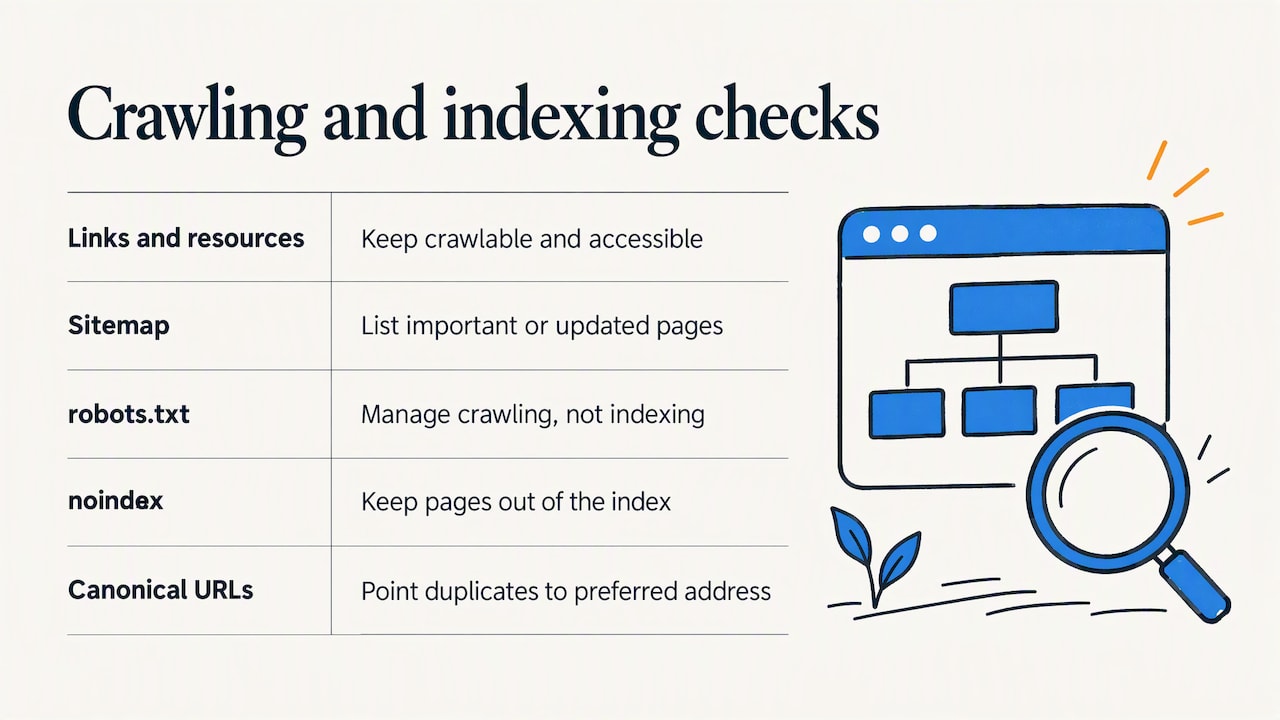
One detail trips up many site owners. Per the same Google guidance, robots.txt is for managing crawling, and sitemaps encourage it. Robots.txt is not the tool for keeping a page out of the index. A provider who mixes these up is a warning sign.
Speed and Core Web Vitals
Google’s Core Web Vitals guidance names three user-experience metrics and recommended thresholds:
| Metric | What it measures | Recommended threshold |
|---|---|---|
| LCP (Largest Contentful Paint) | How quickly the main content loads | Within 2.5 seconds |
| INP (Interaction to Next Paint) | How fast the page responds to taps and clicks | Under 200 milliseconds |
| CLS (Cumulative Layout Shift) | How much the layout jumps while loading | Under 0.1 |
Be realistic about what these buy you. Google says ranking systems use Core Web Vitals, but good scores alone do not guarantee top rankings, because page experience is judged through many signals. Speed work is worth doing for visitors first. A fast site converts better whether or not it moves a ranking.
Mobile and rendering
Google predominantly uses the mobile version of a page. Its mobile-first indexing guidance says mobile pages should expose the same important content and robots directives as desktop, and should not require user interaction to load primary content. Tabs and “read more” buttons that hide your service descriptions are a classic problem here.
Redirects, security and site moves
Redirects carry your old pages’ value to new addresses. HTTPS, which Google also recommends, protects visitors and avoids browser warnings. Redesigns and migrations are where most small-business traffic losses happen, so a redirect map is not optional. We documented one example in our case study on search rankings after moving off WordPress.
Structured data and site architecture
Structured data labels your business details, services and reviews so search engines read them accurately. Site architecture covers how pages link to each other, so your important pages are never buried five clicks deep.
An example of technical SEO work
Here is a concrete case. A contractor’s “Roof Repair” page does not appear in search. An audit uses Google’s URL Inspection tool to render the live page, which Google lists as a way to verify that it sees the page as expected. The render shows the page body is empty, because the content loads only after a script runs that Googlebot is blocked from fetching. The fix is to unblock the resource or serve the content in the page itself. Nothing was wrong with the writing. The page was invisible.

This is the kind of finding you should expect in a deliverable: the affected URL, what is wrong, how serious it is and exactly what to change.
Technical SEO vs. on-page SEO
The two are often sold together, and people searching for one often need the other. Semrush draws the line this way: technical SEO covers backend factors that affect crawlability, user experience and speed, including audits, duplicate content fixes, robots.txt, sitemaps, code and file-size optimization, migrations, mobile-friendliness and site architecture. On-page SEO covers the content itself: keyword targeting, page titles, product descriptions, fresh content, HTML structure and content plans.
| Technical SEO | On-page SEO | |
|---|---|---|
| Question it answers | Can search engines reach and process the site? | Does each page clearly match what people search for? |
| Typical tasks | Crawl fixes, redirects, speed, mobile, sitemaps | Titles, headings, copy, internal links, metadata |
| Frequency | Heavy up front, then periodic checks | Ongoing as pages are added or updated |
| Who does it | Developer-minded SEO | SEO plus writer or editor |
If your site is technically healthy but thin, you need on-page work and content. If your content is strong but not indexed, you need technical work first. Our onsite optimization service covers the page-level side, and for the writing, our blogging service in Virginia Beach keeps fresh local content flowing.
What SEO agency services and content writing services include
A full-service SEO agency typically bundles several layers: a technical audit and fixes, keyword and competitor research, on-page optimization, content creation, local listings and review management, link building and monthly reporting. Content writing services sit inside that bundle or alongside it. They usually produce service pages, location pages and blog posts built around what your customers actually search for.
When you compare proposals, check that each line item names a deliverable. “Technical SEO” with no list of checks is a marketing phrase. “Audit of crawl, indexing, redirects, mobile and speed, with a prioritized fix list and implementation notes” is a service.
AI-driven results now matter too. Search features that summarize answers draw on well-structured, accessible pages, so the technical foundation helps there as well. We cover that work on our AI search optimization page.
How much technical SEO services cost
No official body publishes SEO price lists, so the best public benchmark is survey data. Semrush’s March 20, 2024 survey of nearly 400 SEO providers found U.S. SEO agencies charged an average of $147.93 per hour and U.S. consultants averaged $144.68 per hour. Treat these as a reference point from one survey, not a quote.
The same source says price varies with provider type, pricing model, scope of work, business size and goals, competition, industry, geography and the expertise required. For technical work specifically, these factors drive cost most:
- Site size. A 15-page service-business site and a 5,000-product store are different jobs.
- Platform. Some platforms limit what can be changed, which raises the effort.
- Condition. A site after a botched migration costs more to repair than a clean one.
- One-time vs. ongoing. A fix-it project is different from monthly monitoring.
- Implementation. Some providers hand you a list. Others make the changes.
That last point matters most for small businesses. An audit that lands in your inbox with 80 issues and nobody to fix them is money spent on homework.
What we charge
Our published prices are simple. A typical website design project runs $1,800 to $5,800 one-off. Hosting and site management starts from $55 per month. Local search marketing is $79 per month. Standalone technical SEO and broader SEO engagements are quoted to the site, since scope varies, and we will tell you plainly what your site needs before you commit.
Our perspective: fix the foundation, then spend where it pays
We work only with small, locally owned businesses in Virginia Beach, and that shapes how we see technical SEO. Most of our clients do not need a 90-page audit. They need to know whether Google can see their site, whether it loads well on a phone, and whether anyone searching nearby can find them.
So we start with the basics, and we keep the website, hosting and SEO under one roof. That matters because many technical problems start with how a site was built or where it is hosted. When the same team designs, hosts and optimizes the site, nobody can point fingers at someone else, and fixes happen faster.
We also do not treat technical SEO as a product to upsell. Once the site is crawlable and fast, the next dollar usually does more good in local search, fresh content or a well-run ad campaign than in further technical polishing. Ahrefs says much the same about diminishing returns, and our experience with local businesses agrees.
Finally, we think small businesses should be wary of cold emails promising instant first-page rankings. We wrote about SEO scams because we kept seeing clients pay for them.
— User
How to choose a technical SEO provider
Semrush’s pricing guidance says a small business should weigh the provider’s type, location, experience and track record, services and pricing model, and how all of that fits its size, industry, competition, goals and budget. Turn that into questions you can ask on a call:
- What will I receive? Ask for a sample deliverable with affected URLs, severity and fix instructions.
- Who makes the changes? Find out whether implementation is included, billed separately or left to you.
- How do you measure success? Good answers mention indexed pages, crawl errors, load times and leads, not just rankings.
- Do you know my market? A provider who understands your local competition will prioritize differently from a national shop.
- Can I talk to a human? Responsiveness before you sign is a preview of responsiveness after.
- What are you not promising? Be wary of guaranteed rankings. Google’s own guidance says even good page experience scores do not guarantee top positions.
If you are comparing a local team against a large national agency, remember that scale is not the same as fit. A small business with a 20-page site rarely needs an enterprise process. It needs clear priorities and someone who answers the phone.
Where our SEO services fit
If your site is not showing up, loads slowly or lost traffic after a redesign, our SEO team in Virginia Beach can review it and tell you what is worth fixing. We cover technical checks, on-page work, local SEO and AI search visibility, and we can handle the design and hosting too. Contact us through our site and we will start with a straightforward look at where you stand.
FAQ
What are technical SEO services?
They are the tasks that help search engines crawl, render, index and serve your site correctly. They include fixing crawl errors, managing sitemaps and robots.txt, setting up redirects, improving speed and mobile performance, and adding structured data. They support your content rather than replace it.
How much does technical SEO cost?
It depends on site size, platform, condition and whether the provider implements the fixes. One 2024 survey put the average U.S. agency rate at $147.93 per hour. Ask for a written scope so you can compare proposals on deliverables, not rates alone.
Do I need technical SEO if my site is small?
Often yes, but a lighter version. A small site rarely has crawl-budget problems, yet it can still have blocked pages, slow mobile loading, broken redirects or missing sitemaps. A short audit and a one-time fix usually cover it.
Is technical SEO the same as on-page SEO?
No. Technical SEO concerns how the site functions for search engines. On-page SEO concerns the content and HTML of each page, such as titles, headings and copy. Most sites benefit from both.
Sources
- What Is Technical SEO? The Definitive Guide, Search Engine Land
- The Beginner’s Guide to Technical SEO, Ahrefs
- Google Crawling and Indexing, Google Search Central
- Technical SEO Techniques and Strategies, Google Search Central
- Understanding Core Web Vitals and Google search results, Google Search Central
- Understanding Google Page Experience, Google Search Central
- Mobile-first Indexing Best Practices, Google Search Central
- Types of SEO: What Does Your Site Need to Succeed?, Semrush
- SEO Pricing: What Does SEO Cost & What Affects It?, Semrush